




Overview
Is Niva Bupa Health Insurance good or bad? Many buyers ask this, especially given the insurer’s strong brand presence and its innovative, feature-rich health plans. In this guide, we evaluate its claim performance and service experience, highlight key advantages and limitations, and share practical insights on usability and what to keep in mind before purchasing a policy.
Overview of Niva Bupa Health Insurance
Who They Are
Diverse Offerings
Claims Handling
Performance & Reliability
Some of Niva Bupa’s Popular Plans: Aspire, ReAssure 2.0, ReAssure 3.0, Health Recharge Super Top-up.
Niva Bupa Health Insurance Performance Metrics
Source: This information is sourced from the IRDAI annual reports and Niva Bupa public disclosures. For more data on other insurers, explore Ditto Data Lab.

Key Insights
Claim Settlement Ratio (CSR)
Niva Bupa’s Claim Settlement Ratio has improved consistently, rising from 90.53% in FY 2022–23 to 94.44% in FY 2025–26. Its three-year average for FY 2023-24 to FY 2025–26 stands at 92.92%, slightly above the industry average of 92.02%. The steady improvement is encouraging, although its latest-year CSR still trails some larger insurers.
Average Complaints
Niva Bupa has historically had a higher complaint burden, but the recent trend has improved sharply. The insurer averaged 37.13 complaints per 10,000 claims between FY 2023–24 and FY 2025–26, above the industry average of 29.35. However, complaints fell sharply to 29.19 in FY 2025–26, the lowest level.
Incurred Claim Ratio (ICR)
Niva Bupa maintains an average ICR of 58.10% between FY 2022–23 and FY 2024–25, comfortably within the healthy range of 55–85%. This suggests that the company is paying a reasonable proportion of premiums as claims while ensuring the business remains financially sustainable.
Annual Business / Gross Written Premium (GWP)
Niva Bupa has grown rapidly over the last few years. Its Gross Written Premium increased from ₹4,073.03 crore in FY 2022–23 to ₹8,585.92 crore in FY 2025–26. Its three-year average for FY 2023–24 to FY 2025–26 stands at ₹6,985.24 crore, well above the industry benchmark of ₹4,504 crore, indicating a significant expansion in business scale.
Network Hospitals
With a network of over 10,000 hospitals, Niva Bupa policyholders have access to cashless treatment across a wide range of cities and towns. However, policyholders are advised to verify the latest hospital list before undergoing any treatment to ensure coverage.
Read More: A detailed, in-depth review of Niva Bupa Health Insurance.
Talk to an expert
today and
find
the right
insurance for you.


Benefits of Niva Bupa Health Insurance
1) Flexible Plan Portfolio & Customization
Niva Bupa offers a wide range of plans, including individual, family floater, and super top-up policies. Customers can also choose high or unlimited sum insured options and add riders like Outpatient Department (OPD) coverage or disease management riders. This flexibility lets policyholders customize their health insurance based on age, lifestyle, family needs, and budget.
2) Maternity & Parenthood Coverage
The M-iracle benefit, available in plans like Aspire (including Aspire Platinum+), goes beyond standard maternity cover by including normal and C-section deliveries, IVF, surrogacy, and legal adoption. Unused maternity cover can be carried forward to build a larger fund (with Booster+), and newborns are covered from Day 1, subject to eligibility. Notably, Aspire Platinum+ offers a 9-month maternity waiting period, one of the shortest in the industry, though sub-limits still apply.
3) Coverage Growth & Restoration
Niva Bupa enhances long-term protection through features like Booster+ and ReAssure Forever. Booster+ allows unused sum insured to accumulate, potentially increasing coverage up to 10× the base sum insured. ReAssure Forever triggers after the first claim, providing unlimited reinstatement for the same or different illnesses (without any cooling off period) as long as the policy is renewed.
4) Flexible Hospitalization Coverage
Niva Bupa plans cover modern treatments, daycare procedures, domiciliary, pre- and post-hospitalization care, ambulance charges, organ donor expenses, and AYUSH treatments, ensuring holistic financial protection during medical treatment.
5) Global Coverage
Niva Bupa offers planned overseas treatment through select plans. In ReAssure 3.0, global cover is available via the optional Borderless rider with co-pay choices from 0%–50%, which can lead to high out-of-pocket costs. Health Premia Platinum includes global cover in-built, with no co-pay on hospitalisation but a 20% co-pay on OPD and diagnostics abroad.
Drawbacks of Niva Bupa Health Insurance
1) Higher Complaint Levels Despite Recent Improvement
Niva Bupa’s three-year average stands at 37.13 complaints per 10,000 claims, above the industry average of 29.35. That said, the trend has improved sharply, with complaints falling to 29.19 in FY 2025–26, the lowest level. So, the concern is no longer rising complaint volumes, but that the insurer’s longer-term complaint record remains weaker than the industry average.
2) Cashless Network Reliability Gaps
Although Niva Bupa advertises a large hospital network, cashless availability is not always seamless. In the past, cashless services were temporarily suspended at major chains like Max Hospitals, due to commercial issues. This highlights that network tie-ups can change, so policyholders should always verify hospital eligibility before admission and be prepared for reimbursement if cashless access is unavailable.
3) Complexity in “Innovative” Features
Many of Niva Bupa’s headline features work best when their conditions are clearly understood. Benefits like Lock the Clock and M-iracle maternity come with limits, waiting periods, or exceptions that can reduce their value. These features suit well-informed buyers but may surprise those who assume they apply unconditionally.
4) Discharge & Reimbursement Delays
Some policyholders report delays during cashless discharge, where final approvals take longer than expected, extending hospital stays. In reimbursement cases, payments may sometimes be processed in stages rather than a single settlement, requiring follow-ups for balance amounts. These issues point to process inefficiencies rather than claim denial, but they can be stressful during recovery periods.
Things to Keep in Mind Before Buying Niva Bupa Health Insurance
Study the Policy Wording Carefully
Niva Bupa plans are feature-heavy, and how benefits work in practice depends on specific conditions, triggers, inclusions, and exclusions mentioned in the policy document—not just marketing highlights.
Understand Feature Fine Print
Benefits like Lock the Clock, Booster+, and ReAssure Forever come with reset rules, caps, and eligibility conditions that should be clearly understood upfront.
Keep Disclosures and Documents Accurate
Ensure all health information is correctly disclosed at purchase and maintain complete medical records to avoid claim delays or disputes later.
Choose Riders Wisely
Expenses like consumables and non-medical items may be excluded unless you opt for add-ons such as Safeguard+, which can increase overall costs.
Recheck Hospital Network Status
Even with a large hospital network, cashless tie-ups can change. Always confirm hospital eligibility before planned treatment to avoid last-minute hassles.
Why Choose Ditto for Health Insurance?
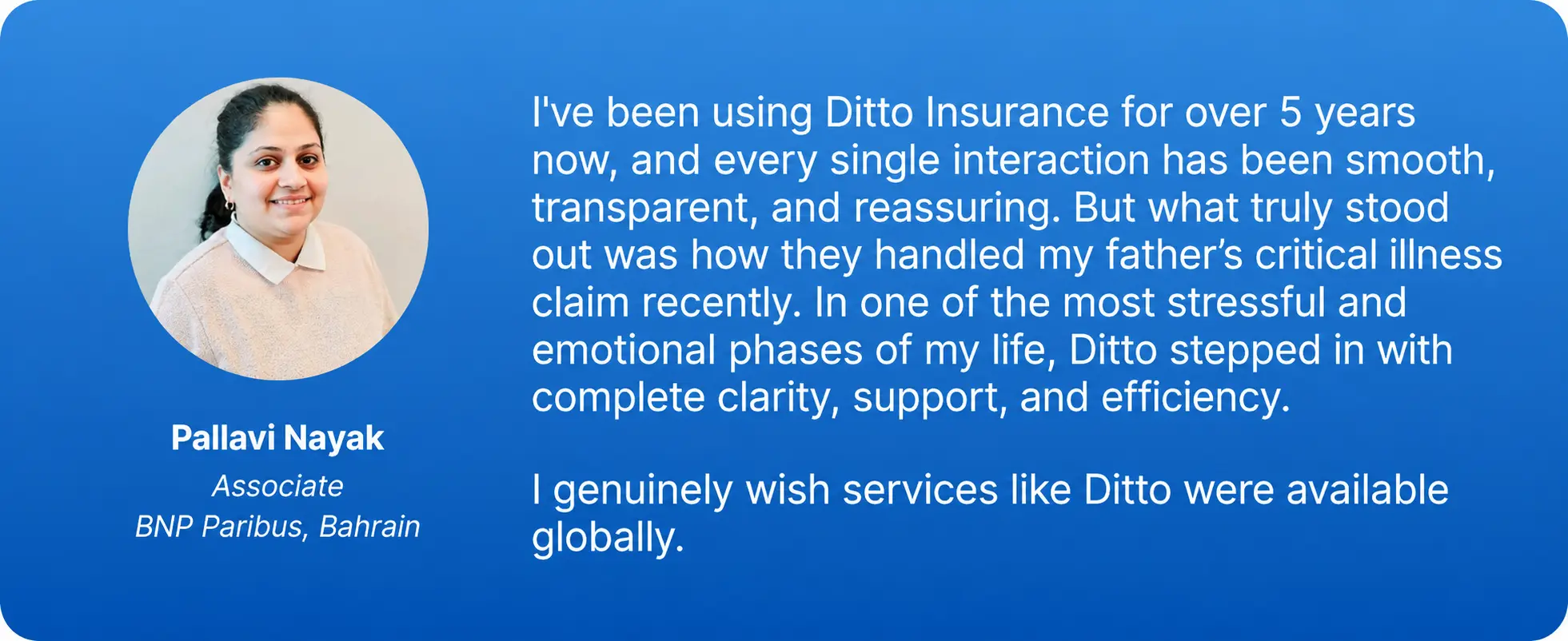
At Ditto, we’ve assisted over 12,00,000 customers choose the right insurance policy. Why customers like Pallavi love us:
- 100% Free Consultation
- No Spam. No Sales Pressure.
- Rated 4.9/5 on Google Reviews by 30,000+ Happy Customers
- Backed by Zerodha
- Dedicated Claim Support Team
- Compare Plans and Premiums with a Trusted Insurance Advisor
Confused about the right insurance? Speak to Ditto’s certified advisors for free, unbiased guidance. Book your call now or chat with us on WhatsApp. Slots fill up fast!
Ditto’s Take on Niva Bupa Health Insurance
Niva Bupa has become a more compelling insurer than it was a few years ago. Its products remain feature-heavy, but the bigger change is operational. Complaints per 10,000 claims fell to their lowest level in the available series in FY 2025–26, while the Claim Settlement Ratio improved to 94.4%. The insurer has also become more flexible in underwriting certain medical conditions, which gives it a practical edge in cases where other comprehensive plans are harder to access.
That said, the right Niva Bupa plan depends on your family’s specific needs. Its claim settlement ratio and hospital network are competitive, although some peers perform better on these metrics. ReAssure 3.0 also differs significantly across variants, so it is important to compare room eligibility, coverage limits, and add-ons carefully. Features like Lock the Clock are useful, but premiums can still change if the insurer revises product pricing.
Niva Bupa makes the strongest case where its product design solves a specific need, such as broader underwriting flexibility, newborn coverage under Aspire, or an unlimited sum insured option under ReAssure 3.0. For families without these specific requirements, it is worth comparing Niva Bupa against the best health insurance plans in India before deciding.
Frequently Asked Questions
Last updated on: