Child health insurance in India helps parents cover pediatric medical expenses like hospitalization, day care treatments, pre- and post-hospitalization costs, ambulance charges, and illnesses or injuries as children grow.
Ditto’s top pick is HDFC ERGO Optima Secure Plus, backed by a 96.71% average claim settlement ratio from FY 2022-25 and a 13,000+ hospital network. Ditto rates plans on features, insurer reliability, and premium value. For example, a family in Delhi with 2 adults and a 2-year-old pays ₹25,512 per year for a ₹15 lakh floater.
This guide is for parents comparing family floater plans, individual child policies, and multi-individual setups for kids.
If you’re a parent, you’ve already dealt with the late-night doctor visit, the surprise blood test, or the school injury call. Most of the time, it’s manageable, but every once in a while, a hospital bill lands that’s big enough to make you pause.
Child health insurance is simply a way to prepare for those bigger, less predictable expenses, without dipping into long-term savings or compromising on care.
In this guide, we’ll walk you through the best health insurance plans for children in India, including premiums, how coverage works, and what’s included and what's not.
Features: Room rent rules, co-pays, waiting periods (and reduction options), restoration, bonus, consumables, and key exclusions.
Insurer: Claims and service track record based on IRDAI disclosures, complaint volume, business scale, and hospital network strength.
Premium: Whether the plan is meaningfully priced for what it offers.
Best Health Insurance Policy for Children in India: Detailed Comparison
01
HDFC Ergo
Optima Secure Plus
HDFC ERGO Optima Secure+ is a newly launched plan. The insurer is reliable with a 96.71% average claim settlement ratio (FY 2022-25), 9.28 complaints per 10,000 claims, a big hospital network (13,000+).
HDFC Ergo
Optima Secure Plus
4.6
Overall Rating
Insurer Rating
5.0/5
Customer Service
5.0/5
Premium Rating
3.0/5
Feature Rating
4.6/5
Why Optima Secure Plus Stands Out for Children:
Optima Secure Plus lets you insure kids from 91 days of age, and dependent children can stay on the family plan until age 26, after which they can be migrated to their own policy with continuity of benefits.
Key Highlights:
Secure Benefit: It doubles your base sum insured from the start of the policy. For example, a ₹10 lakh base cover gives you ₹20 lakh effective cover from day one.
Infinite Benefit: Every year, 100% of the base sum insured is added to your cover, with no upper cap, even if you made a claim in the previous year.
Unlimited Restoration: The plan by default restores the base sum insured multiple times in the same policy year for related and unrelated illnesses.
Protect Benefit: It covers listed non-medical expenses such as gloves, masks, syringes, nebulizer kits, and similar items.
No Major Restrictions: The plan has no co-payment, no room rent cap, and no disease-wise sub-limits.
Useful Add-ons: ABCD Chronic Care, Optima Wellbeing, Parenthood, Limitless, and Serious Illness Booster.
Things to Keep in Mind:
Premiums are higher than most peers, although you could argue that you’re paying for reliability and bundled extras.
02
Care
Care Supreme
Care Supreme is one of Care Health’s flagship retail plans. As the second-largest standalone health insurer in India, it brings both - policy benefits and compelling pricing to the table.
Care
Care Supreme
4.5
Overall Rating
Insurer Rating
4.2/5
Customer Service
3.0/5
Premium Rating
5.0/5
Feature Rating
4.5/5
Why Care Supreme Stands Out for Children:
Care Supreme covers children from 90 days up to 25 years. On the insurer side, Care Health is solid, though not spotless. It has an average CSR of 93.13% (FY 2022-25) and 42 complaints per 10,000 claims.
Key Highlights:
Unlimited Automatic Recharge for related & unrelated illnesses.
Cumulative Bonus up to 100% (option to extend by 500% or unlimited accumulation through add-ons).
Claim Shield add-on covering consumables. It comes in two variants, the regular and plus, which provide an extended scope for coverage.
Wellness discounts: earn up to 30% off renewals through fitness-linked benefits.
Unique add-ons for comprehensive waiting period reduction for existing diseases, GYM Memberships, OPD Cover, Unlimited Coverage once, and Air Ambulance.
Things to Keep in Mind:
Service can be uneven, and complaint volumes are higher than peers'.
03
Aditya Birla
Activ One MAX
Activ One MAX is built for younger, health-focused families who want rich benefits at a sensible price. Aditya Birla has an average CSR of 95.81% (FY 2022-25) and 18.66 complaints per 10,000 claims. The plan leans into wellness without skipping on core protection.
Aditya Birla
Activ One MAX
4.4
Overall Rating
Insurer Rating
4.5/5
Customer Service
5.0/5
Premium Rating
5.0/5
Feature Rating
4.3/5
Why Activ One MAX Stands Out for Children:
Activ One MAX allows children on a floater or multi-individual basis from 91 days, to 26 years as dependents, and even offers a stand-alone child policy from age 5 onwards with the parent as the proposer.
Key Highlights:
Unlimited restoration (usable for related & unrelated illnesses) available from the 2nd claim of the policy lifetime
Cumulative bonus of 100% per year up to 500% given regardless of claims made (max up to ₹3 crore)
HealthReturns that reward fitness/healthy living with discounts on renewal premiums up to 100%
Various add-ons for pre-existing disease waiting period reduction
Things to Keep in Mind:
Insurer is newer, so servicing isn’t as seamless as HDFC ERGO/Bajaj Plus, wellness-linked benefits pay off only if you thoroughly engage with the program. We’ll be honest, achieving a 100% discount may be challenging, but savings of 10-50% are achievable through regular fitness activities.
04
Niva Bupa
ReAssure 2.0 Platinum+
ReAssure 2.0 Platinum+ is the feature-heavy flagship, designed for long-term cover and high utilization. For families with children, its age-flexible design and strong restoration and booster features can be very reassuring over the decades.
Niva Bupa
ReAssure 2.0 Platinum+
4.3
Overall Rating
Insurer Rating
4.2/5
Customer Service
3.0/5
Premium Rating
5.0/5
Feature Rating
4.2/5
Why ReAssure 2.0 Stands Out for Children:
ReAssure 2.0 covers dependent children from 91 days till maximum entry age of 30 years, without any exit age. This gives you an option to keep your kids on the family plan as long as you want. After 31 years of age, they can also choose to migrate to an individual policy, carrying forward the benefits accumulated.
Key Highlights:
ReAssure+: unlimited restoration of cover, every claim up to SI.
Age-lock on premium until first claim (premiums can still increase due to medical inflation).
Booster+: unused SI carried forward up to 5× (up to 10x in the Titanium+ variant).
Safeguard/Safeguard+: covers non-payables + inflation-linked sum insured hikes + No impact on Booster+ if claim in a policy year is up to ₹50,000-1,00,000.
Things to Keep in Mind:
Age-lock resets after a claim, and premiums can still be repriced by the insurer due to medical inflation and spikes in operational and claim costs. Post-sales servicing and claims experience is not as uniform as the very top players.
05
SBI
Super Health Platinum Infinite
Super Health Platinum Infinite is SBI General’s all-out, high-feature health plan. For families with children, it’s more of a “go big” option: very strong cover, higher sums insured, and benefits designed for serious, complex claims.
SBI
Super Health Platinum Infinite
4.1
Overall Rating
Insurer Rating
3.8/5
Customer Service
3.0/5
Premium Rating
5.0/5
Feature Rating
4.2/5
Why Super Health Platinum Infinite Stands Out for Children:
The plan covers dependent children from 91 days up to 30 years, giving you plenty of time to keep them protected under one large floater before splitting them out. Extended coverage, such as OPD cover, can be useful for frequent doctor visits for children.
Key Highlights:
Unlimited reinstatement; up to 200% SI per claim (ReInsure Benefit).
Health Multiplier: up to 3× cover for 37 listed serious illnesses.
Global cover for 16 conditions + air ambulance ₹10 lakh.
OPD and consumables are covered, built in.
Shorter waiting periods: Pre-existing Disease 2 years, specific diseases 1 year.
Wellness add-ons: The insurer provides Health Assistance (AI Personal Fitness coaching), a Dietitian and Nutrition E-consultation, and an unlimited gym membership.
Renewal Discount: SBI General offers a renewal discount based on the number of steps walked by the insured members, up to 30%.
Things to Keep in Mind:
The Global Cover and Health Multiplier apply only to listed conditions. Premiums are quite expensive due to the policy's overindulgent nature and a higher base cover amount (min ₹50 lakh).
Note: If you'd like to explore the detailed figures reported by insurers and the IRDAI in their annual disclosures and public reports, visit Ditto Data Labs, our proprietary repository of health insurance data, meticulously compiled, verified, and maintained by the Ditto team over the years.
Talk to an expert today and find the right insurance for you.
Premium Comparison of the Best Child Health Plans
Profiles
HDFC ERGO Optima Secure Plus
Care Supreme
Aditya Birla Activ One MAX
Niva Bupa Reassure 2.0 Platinum +
(Family Floater, 2A): Ages (32, 31)
₹21,128
₹23,153
₹16,299
₹20,183
(Family Floater, 2A 1C): Ages (34, 33, 2)
₹25,512
₹29,257
₹21,478
₹26,343
(Family Floater, 2A 2C): Ages (36, 35, 5, 2)
₹31,887
₹38,481
₹30,259
₹31,142
Here, "A" stands for adult and "C" denotes children.
Note: These are indicative premiums for a Delhi resident (pin code: 110001) with a ₹15 lakh sum insured, including mandatory and recommended add-ons. Your premium can change based on age, city, medical history, plan variant, and chosen add-ons.
How Child Health Plans Work in India?
Family Floater - One shared sum insured for the whole family (for example, 2 adults + 1 or 2 children). It’s usually the most affordable way to start: add the child as a dependent.
Individual Child Plan - The child receives an individual policy in their own name, with the parents as the proposer (applicant). This structure ensures the child’s coverage remains untouched even if parents make large claims. For example, the Care Advantage plan offers individual policies for children starting at age 5.
Multi-Individual Setup - Each family member has an individual sum insured under the same policy with the insurer. Think of it as “individual for everyone”, but easier to manage because all policies can be renewed together. Plans like HDFC ERGO Optima Secure and Aditya Birla Activ One MAX allow for a multi-individual set-up.
Here’s how coverage changes across different age groups.
1) Newborns (0-90 days)
Most retail health plans do not cover a baby from the day of birth. Typically, a child can be added only after 90 days of age. This 3-month rule is mainly about risk: the first few weeks of life are medically fragile, and insurers want to avoid that risk.
A key exception is maternity with newborn cover. If the parent already has maternity insurance and the delivery is covered, insurers allow the newborn to be covered from day 1.
2) Regular-Age Children (91 days up to 18 years)
This is when most child-related claims happen, like fevers, infections, minor surgeries, and injuries from sports or accidents. Health insurance here works much like it does for adults. Hospital bills are paid in accordance with policy terms, such as room-rent limits, exclusions, and co-pays. Most insurers allow children to be added to a family floater with an additional premium.
3) Adult Children (18 to 25 years)
Most policies allow children to remain dependents until a certain age. This differs from plan to plan, but is usually 25 or 26. After that exit age, insurers offer migration to an individual policy, or their own floater, with continuity of benefits intact. This transition is important to plan for, especially if your child has accumulated bonuses or served waiting periods.
Did You Know?
Under Care Ultimate, if you add your baby within 90 days of birth, the newborn can inherit the waiting periods you’ve already served as the primary insured - they don’t restart from zero.
Inclusions and Exclusions of Health Insurance for Kids
What’s Covered
What’s Not Covered
In-patient hospitalization
Investigation and evaluation only
Pre-hospitalization expenses
Rest cure, rehabilitation, and respite care
Post-hospitalization expenses
Obesity or weight control treatments
Day care treatments
Gender change or related treatments
Organ donor expenses
Cosmetic or plastic surgery
Modern treatments (robotic surgery, stem cell therapy, etc.)
Hazardous or adventure sports injuries
AYUSH treatments (Ayurveda, Homeopathy, etc.)
Treatment breaching the law
Road ambulance charges
Unproven treatments or experimental procedures
Domiciliary treatments
Sterility and infertility treatments
-
Maternity (unless specifically covered)
-
Wellness or rejuvenation therapies
-
Dietary supplements or alternative substances
-
Substance abuse or alcohol-related treatments
It’s worth noting that coverage and exclusions may vary slightly across insurers and plans.
Why Should You Buy Children Health Insurance?
01
Higher Chances of Medical Expenses
Children run, jump, and experiment without thinking too much about consequences. They also pick up infections easily at school, daycare, and during seasonal changes. While many illnesses are routine, some require hospitalization and can quickly add up to significant bills that insurance may not cover.
02
More Risk Exposure
Urban pollution, crowded spaces, and changing food habits all add to a child’s overall health risk. You can’t eliminate these factors, but you can make sure that if they lead to serious illness, the financial side is taken care of.
03
Poor Lifestyle Habits
High screen time, junk food, and less physical activity are now common. Over time, this can lead to health issues earlier in life, and having a good health plan means your child can access proper care without long debates over cost.
Why Talk To Ditto For Health Insurance?
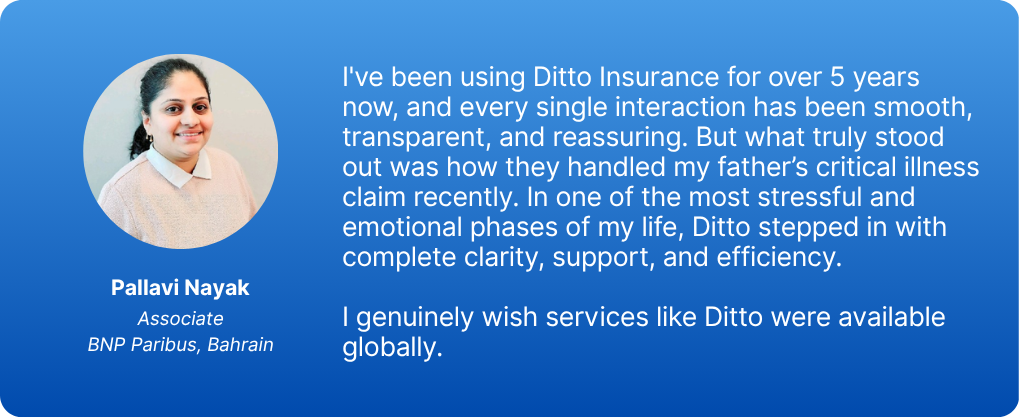
At Ditto, we’ve assisted over 8,00,000 customers with choosing the right insurance policy. Why customers like Pallavi below love us:
No-Spam & No Salesmen
Rated 4.9/5 on Google Reviews by 15,000+ happy customers
Confused about the right insurance? Speak to Ditto’s certified advisors for free, unbiased guidance. Book your call or chat on WhatsApp with us now!
Ditto’s Take on Kids Health Insurance
There is no single “perfect” health insurance for children. For most families, it makes sense to start early with a solid family floater and add your child as soon as they’re eligible. This keeps premiums reasonably low and builds a history that’s easy to continue later.
If you’re planning a baby, focus on how the plan handles maternity and newborns - the waiting period, what’s covered at birth, and when the baby gets full coverage. As your child grows older, you can always rethink the structure and move them to an individual policy to protect their coverage.
In simple terms: build a solid, reliable base cover you can keep for years, and then fine-tune it as life changes.
Disclaimer
We believe in full transparency around our partnerships. Our current insurer partners are HDFC Ergo, Care, Aditya Birla, and Niva Bupa. But as you can see in this list, the rankings include both partners and non-partners because the methodology is unbiased and applied uniformly across all insurers.
Frequently Asked Questions
What is the best health insurance plan for children in India in 2026?
At Ditto, we recommend HDFC ERGO Optima Secure Plus as the top pick for children's health insurance in India. It covers children from 91 days of age, allows them to stay on the family plan until age 26, and is backed by a 96.71% average claim settlement ratio from FY 2022-25. The plan doubles your sum insured from day one through its Secure Benefit and adds 100% of the base cover every year with no cap. Other strong options include Care Supreme, Aditya Birla Activ One MAX, and Niva Bupa ReAssure 2.0 Platinum Plus.
Should I add my child to a family floater or buy a separate individual health plan for them?
For most families, starting with a family floater is the most practical and affordable approach. It lets you add your child as a dependent under the same shared sum insured, which keeps premiums manageable. The downside is that if adults make large claims, the child's coverage gets used up too. An individual child plan, where parents are listed as the proposer, keeps the child's cover separate and untouched. Plans like Care Advantage offer individual policies for children starting at age 5. At Ditto, we suggest evaluating both options based on your family's claim history.
When can I add a newborn baby to health insurance in india?
Most retail health plans in India allow a newborn to be added only after 90 days of birth. Insurers apply this 3-month rule because the first few weeks of life carry higher medical risk. The exception is if the parents already have maternity coverage. Under maternity insurance with newborn cover, the baby can be covered from day one of birth. Under Care Ultimate, for instance, if the baby is added within 90 days of birth, the newborn inherits the waiting periods already served by the primary insured, so they do not restart from zero.
How much does health insurance for children cost in India?
The premium depends on the family structure, city of residence, sum insured, and chosen add-ons. As a reference, a Delhi-based family with 2 adults aged 34 and 33 and a 2-year-old child pays around ₹25,512 per year for a ₹15 lakh sum insured under HDFC ERGO Optima Secure Plus. The same profile under Care Supreme costs approximately ₹29,257 per year, while Aditya Birla Activ One MAX comes in lower at around ₹21,478. These are indicative premiums and can vary based on age, pin code, and medical history.
What does children's health insurance cover in India?
Children's health insurance in India typically covers in-patient hospitalization, pre- and post-hospitalization expenses, day care treatments, road ambulance charges, domiciliary treatment, organ donor expenses, and modern treatments like robotic surgery and stem cell therapy. AYUSH treatments such as Ayurveda and Homeopathy are also included under most plans. Some plans also cover OPD consultations and consumables through add-ons. Coverage terms, including room rent limits and sub-limits, can vary across insurers. At Ditto, we recommend reading the policy wordings carefully to understand exactly what is and is not included before you buy.
What is not covered under health insurance for kids in India?
Standard children's health plans in India typically exclude treatments for obesity, gender reassignment, cosmetic or plastic surgery, sterility and infertility, substance abuse, and wellness or rejuvenation therapies. Injuries from hazardous or adventure sports are also usually excluded, along with experimental or unproven procedures. Maternity is not covered unless the plan specifically includes it as a benefit. Investigations done without subsequent hospitalization and rest or rehabilitation care are also generally not reimbursed. Exclusions can vary by insurer and plan, so it is always worth reviewing the specific policy document before purchasing.
At what age should I buy health insurance for my child?
The earlier you buy, the better. Most plans allow children to be covered from 91 days of age, and buying early means your child starts accumulating cumulative bonuses and serving waiting periods sooner. Under Aditya Birla Activ One MAX, for example, a standalone child policy is available from age 5 with the parent as the proposer. Delaying coverage increases the risk of a gap in protection during the years when children are most prone to infections, injuries, and hospitalizations. At Ditto, we suggest adding the child to a family floater as soon as they are eligible.
What is the exit age for children in family floater health insurance plans?
Exit ages for dependent children vary across plans. HDFC ERGO Optima Secure Plus and Aditya Birla Activ One MAX allow children to stay on the family plan up to age 26. Care Supreme covers dependent children up to age 25, while SBI Super Health Platinum Infinite extends coverage up to age 31. Niva Bupa ReAssure 2.0 Platinum Plus is the most flexible, with no exit age for dependent children. After the exit age, most insurers offer migration to an individual policy with continuity of benefits preserved, so accumulated bonuses and served waiting periods are not lost.
What happens to my child's health insurance when they turn 25 or 26?
When a dependent child reaches the exit age on the family floater, most insurers offer the option to migrate them to an individual policy or their own floater. This migration is important because it preserves continuity of benefits, meaning the child retains their accumulated cumulative bonus and does not have to restart waiting periods. Under Niva Bupa ReAssure 2.0, children above 31 years of age can migrate to an individual policy carrying forward accumulated benefits. At Ditto, we recommend planning this transition in advance so there is no gap in coverage or loss of the benefits built up over the years.
What should I look for when comparing health insurance plans for children in india?
At Ditto, we evaluate children's health plans on three core factors: features, insurer reliability, and premium value. On features, look for no co-payment, no room rent cap, unlimited restoration, and generous cumulative bonus. On the insurer side, check the claim settlement ratio and complaint volume. HDFC ERGO, for instance, averaged a 96.71% claim settlement ratio from FY 2022-25 with only 9.28 complaints per 10,000 claims. On pricing, compare premiums relative to what is included. Also check the child exit age, whether newborns can be added, and what happens when the child ages out of the family plan.
Customer Reviews
4.9
20915 reviews
Ditto is doing really great. Absolutely spam free- that's the best part. They don't talk to you like they are forced to sell the product. It's more like, helping us buy better. Advisor Nuha was very patient and answered all my questions with clarity. Thanks for the service
I
INDHUMATHI M
Loved the service! Maheta Nidhi Hitesh was incredibly helpful and knowledgeable. She guided me through the whole process and made everything super easy to understand. I really appreciated how patient she was with all my questions—there was no pressure at all, just clear and honest advice. Honestly, I'm very happy with my experience at Ditto so far. Highly recommend!
RK
Ragul Kumar
I had a great experience with Ditto while exploring health insurance options. The process was smooth and everything was explained clearly.
A special thanks to Swaroop SK for patiently answering all my questions and guiding me through the policy details without any pressure. The transparency and support made it much easier to understand and choose the right plan.
Really appreciate the assistance!
PS
Pulkit Singh
Had a great experience with Ditto Insurance. Ishita Sudrania was extremely helpful in guiding me through choosing the right term plan. There was no spamming or sales pressure, and all my questions were patiently answered. She also assisted me thoroughly with the entire application process. Highly recommend!
SS
Samil Shah
I had a great experience with Ditto while filing my health insurance claim. Their team guided me clearly through the entire process, helped with the required documents, and promptly answered all my queries. Their support made the claim process much smoother and less stressful. Highly appreciate their assistance.