To buy health insurance in India, compare plans online through an insurance advisory platform like Ditto. Start by deciding who needs coverage, understanding their medical history, and comparing plans based on coverage, restrictions, insurer reliability, and premiums.
Key Factors to Check
Sum Insured: Consider ₹15 lakh to ₹25 lakh as a practical base cover. You may need more if you live in a metro, prefer large private hospitals, are older, or have pre-existing conditions.
Claim Restrictions: Prefer plans without room-rent limits, mandatory co-payments, or disease-wise sub-limits.
Waiting Periods: Check waiting periods for pre-existing diseases and specific treatments before buying.
Coverage Boosters: Look for useful restoration benefits and bonuses that can increase or refill your coverage.
Insurer Quality: Compare claim settlement ratio, incurred claims ratio, complaint volume, and hospital network before choosing an insurer.
Popular Types of Plans
Individual: Gives one person a dedicated sum insured.
Family Floater: Covers multiple family members under one shared sum insured.
Super Top-Up: Provides affordable additional coverage above an aggregate deductible.
On paper, health insurance coverage in India looks extensive. As per IRDAI’s Annual Report 2024-25, general and health insurers covered about 58 crore lives. But here’s what that number does not show: only about 10.3% of these covered lives were under individual health insurance policies. The rest were largely covered through group policies and government schemes.
That is where the problem begins. Your office health plan does not stay with you if you switch jobs. A government scheme may not apply to your family or may not be applicable in your preferred hospital. Even when you are covered, the sum insured may not be enough.
This is why buying your own health insurance early matters. If you wait until you need it, pre-existing conditions, higher premiums, and waiting periods can make it harder to get the plan. Buying health insurance online is easier today, but knowing what to check before paying is still important.
This guide discusses the types of health insurance plans, how to choose the right sum insured, key features to check, how to compare insurers, and a step-by-step process for buying health insurance online through Ditto.
Types of Health Insurance Plans Available in India
Not all health insurance plans work the same way. According to IRDAI, health insurance policies can be broadly classified into two categories:
Benefit-Based Health Insurance Plans
These plans pay a fixed amount when a specific insured event happens, regardless of the actual hospital bill.
For example, critical illness insurance pays a fixed lump sum if the policyholder is diagnosed with a listed illness such as cancer, stroke, or kidney failure.
Indemnity-Based Health Insurance Plans
These are the more common “standard” health insurance plans. They cover actual medical expenses, such as hospitalization costs, doctor fees, medicines, surgeries, and pre- and post-hospitalization expenses, up to the policy’s sum insured.
Covers one person, where the entire sum insured is reserved only for that insured member.
02
Multi-Individual Health Insurance
Covers multiple family members under a single policy, but each member has a separate sum insured.
03
Family Floater Plans
Cover the entire family under a single shared sum insured, which any member can use during the policy year.
04
Senior Citizen Health Insurance
Designed for people above 60 years and usually comes with higher premiums, stricter underwriting, and possible co-payment clauses.
05
Group Health Insurance
Usually provided by employers or organizations, but the coverage for group health insurance is tied to the group and ends when you leave the job or membership.
06
Top-Up Plans
Add extra coverage on top of a fixed deductible, and payouts occur only when a single hospital bill exceeds that deductible.
07
Super Top-Up Plans
Add extra coverage on top of a fixed deductible. But super top-ups consider the total hospital bills in a policy year, making them more useful for multiple or recurring hospitalizations.
08
Maternity Health Insurance
Covers delivery-related expenses and related care. But maternity insurance usually comes with waiting periods, sub-limits, and specific policy conditions.
Individual vs Family Floater vs Group Plans: What to Choose?
This is one of the most common questions people have when deciding to buy health insurance, and the answer depends on your life stage.
If you are single or have existing health conditions, an individual plan works better. The sum insured is not shared, and coverage is tailored entirely to your needs.
If you have a young family with a spouse and children, a family floater is usually more cost-effective. One policy, one premium, and the cover is shared across everyone. The trade-off is that multiple claims in the same year can exhaust the shared sum insured.
Important Points
Adding Parents to Family Floater
Do not add them to your family floater. Parents are older and more likely to make claims, which can quickly exhaust the shared cover and leave the rest of the family underprotected. Their inclusion also pushes the premium up significantly. A separate plan (either individual or family floater) for your parents is the better move.
Group Insurance From Your Employer
It is a useful supplement, but not a replacement. It ends the moment you change jobs, take a break, or retire. Always maintain your own personal policy independent of your employment, which is renewable lifelong.
How Much Sum Insured Should You Buy?
Most people approach this backward. They try to predict the exact hospital bill they might face one day.
Instead, try to pick a cover that prevents the “I had insurance, but still had to arrange a few lakhs” moment.
Directly From Experts
A simple rule of thumb to follow.
Start with ₹5 lakh. Then add ₹5 lakh for every “YES” below:
Do you live in a metro city?
Do you prefer private/corporate chain hospitals over local ones?
Are you above 45?
Do you have any pre-existing conditions?
A Ditto customer had a ₹10 lakh base cover, a common “round figure” many people choose, thinking it would cover most hospitalizations.
During a cancer treatment admission, the hospital’s initial estimate looked manageable and was close to the cover. But as treatment progressed, costs increased, and the hospital submitted an enhancement request for a higher cashless limit.
The insurer approved cashless in parts, but only up to the maximum sum insured. The final bill was confirmed at discharge, ₹12 lakh. The insurer paid ₹10 lakh, and the customer had to pay the remaining ₹2 lakh out of pocket.
Takeaway: Start with a decent base cover from day one. During claims, once your base sum insured is exhausted, the remaining bill comes straight from your pocket, since even the restoration benefit is applicable from the second claim.
So, if you want a practical number that can cover you in most situations, ₹15 to ₹25 lakh is a sensible base cover.
₹10 lakh can work if you are young, healthy, in a smaller city, and fine with local hospitals.
₹15 lakh is a strong baseline for metro residents.
₹20 to ₹25 lakh is a safer choice if you prefer chain hospitals, are older, have health conditions, or are buying a family floater.
Increasing your cover from ₹10 lakh to ₹20 lakh does not double your premium. The increase is around 20%-30%, a relatively small step up compared to the extra coverage you get with the policy.
Did You Know?
Your cover does not always have to be a fixed number. Some plans can make your cover grow far beyond the base amount over time.
For example, Aditya Birla Activ One MAX can increase your cover by 100% per annum up to 500% (even if you make a claim). It also has a refill feature that restores the sum insured unlimited times, during the year, which helps if there are multiple hospitalizations.
Key Features to Understand in Any Health Insurance Plan
Claim Pay-Out Restrictions
Check for room rent limits, co-payment, and disease-wise sub-limits before buying a plan. A room rent cap can trigger proportionate deductions, a co-payment makes you pay a fixed share of every claim, and disease-wise sub-limits restrict payouts for specific treatments. Ideally, choose a plan with no restrictions.
Waiting Periods
All plans come with waiting periods. IRDAI caps the waiting period for pre-existing diseases at 36 months. Specific illnesses, such as cataracts and joint replacements, typically have waiting periods of 1 to 2 years. The earlier you buy, the sooner these waiting periods will be over.
Coverage Boosters
Check how the plan improves your coverage through restoration, No-Claim Bonus (NCB), and loyalty bonus. Restoration refills your sum insured after a hospitalization claim. NCB increases your cover for claim-free years, while a loyalty bonus increases coverage simply for staying with the insurer. Ideally, look for unlimited restoration and bonuses that do not reduce sharply after a claim.
Pre and Post Hospitalization
Medical bills extend beyond your hospital stay. A solid plan should cover 30 to 60 days of pre-hospitalization expenses (tests, consultations before admission) and 60 to 180 days of post-hospitalization costs (follow-ups, medications, physiotherapy after discharge).
Talk to an expert today and find the right insurance for you.
How Ditto Can Help You Find the Right Plan
Choosing health insurance involves a lot of fine print. Getting it wrong can mean paying out of pocket, even with insurance. That is where Ditto helps.
On the Ditto website, you can explore health insurance in multiple ways.
You can understand policies in simple language
Compare health plans side by side
Read detailed health insurance articles and guides
If you still have questions, you can book a free call with Ditto’s IRDAI-certified advisors. Our advisors are extensively trained in health insurance and can help you understand policy terms, choose the right sum insured, compare plans, evaluate premiums, and make sense of exclusions, waiting periods, room rent limits, restoration benefits, and claim-related conditions.
Did You Know?
Ditto goes beyond just helping you buy a policy. You can reach out for assistance with claims, policy changes, renewals, or any confusion that arises after purchase. And the best part? This guidance comes at no extra premium. Ditto’s service is free, so you get expert help at no extra cost on the same plan.
How to Pick the Best Insurer?
The policy is only as good as the insurer behind it. A plan with great features on paper can still fail you if the insurer has a poor claims track record. Here is what to check:
Claim Settlement Ratio (CSR): The percentage of claims settled vs. total claims received. Look for 90% or above, ideally 95% and higher.
Incurred Claim Ratio (ICR): How much of the premium collected goes toward settling claims. A balanced ICR of 50% to 80% suggests a stable, well-managed insurer.
Network Hospitals: Ideally above 10,000 across India, but do check whether the insurer's network includes hospitals in your city, especially those you would actually use for treatment.
Complaint Volume: Fewer complaints per 10,000 claims, as reported by IRDAI, is a sign of smoother customer service and claims handling.
(Family Floater, 2A) Senior Couple: Ages 62 and 61
NA
₹85,544
₹73,156
Note: A stands for adult and C stands for child. These are indicative premiums for a Delhi resident (Pincode: 110001) with a ₹15 lakh sum insured, including mandatory and recommended add-ons. Your premiums can change based on age, city, medical history, plan variant, and chosen add-ons.
For senior citizens, HDFC ERGO Optima Secure can be considered as an alternative to Optima Secure+.
Documents Required to Buy a Health Insurance Policy
You do not need a long list of documents to buy health insurance online. Here is what is typically required:
Identity & Age Proof: Aadhaar card, PAN card, Voter ID, or Passport.
Medical Reports: Required if you have pre-existing conditions or are above a certain age, usually 45 years and above.
If you are adding family members to the plan, the same documents are needed for each person being insured.
How to Buy Health Insurance Online Through Ditto: Step-by-Step
Buying health insurance online through Ditto is straightforward. Here is exactly how it works:
Step 1: Book a Free Call or WhatsApp Ditto
Ditto's IRDAI-certified advisors help you shortlist 2-3 plans based on your age, city, family structure, and health history. This is completely free and takes about 30 minutes.
Step 2: Compare Shortlisted Plans
Compare plans and review options side by side. Check features, premiums, add-ons, exclusions, and waiting periods before deciding.
Step 3: Fill the Proposal Form
Once you select a plan, complete the proposal form online. This includes personal details, health declarations, and information on members being covered.
Step 4: Disclose Your Medical History Honestly
Declare all pre-existing conditions, past surgeries, lifestyle habits (smoking, drinking), and current or past medications.
Step 5: Pay the Premium Online
Pay via UPI, net banking, or credit or debit card. Once payment is confirmed, the insurer starts processing your application.
Step 6:Complete a Tele-Medical or Medical Test if Required
Some insurers may request a tele-medical call or a pre-policy medical test, depending on the age, sum insured, and medical history of the members being covered. In a tele-medical call, the insurer verifies your health declarations over the phone.
Step 7: Wait for the Insurer’s Decision
If there is some medical history, the insurer may also give a counteroffer. This could include premium loading, an additional waiting period for a disclosed condition, or changes in coverage terms. Ditto helps you understand the counteroffer before you decide whether to accept it.
Step 8: Receive Your Policy Document
If it is a simple application with no major medical history, the policy may be issued immediately or within a couple of days. However, if there is a complex medical history or multiple disclosures, the process may take 1 to 2 weeks because the insurer may ask follow-up questions, request additional documents, or review medical reports. Once the insurer approves the application, the policy document arrives via email. Store a digital copy and share it with your family.
Things to Keep in Mind Before Buying Health Insurance
Exclusions
Every plan has treatments, conditions, or situations it will not cover. Some exclusions apply only for a waiting period, while some may be permanent. Read this section carefully so you know exactly where the policy may not help.
Full Disclosure
Be honest about your health history, past surgeries, ongoing medication, and existing illnesses. Insurers use these details for underwriting, premiums, waiting periods, or specific exclusions. Hiding details can create trouble during claims that could have been avoided otherwise.
Premium Is Not Everything
A cheaper plan may look attractive today, but it will cost more during hospitalization. Watch out for room rent limits, co-payments, disease-wise sub-limits, and weak restoration benefits. Always opt for consumables coverage (PPE kits, cotton balls, gloves, etc.) since they form around 5%-10% of the hospital bill. A slightly higher premium is often worth it if the coverage is more comprehensive.
Moratorium Period
After 60 continuous months, insurers cannot question a claim for past non-disclosure or misrepresentation, except in cases of proven fraud or permanent exclusions. But this is not a free pass to hide medical details. The safest route is still to disclose everything upfront and renew the policy without breaks.
Why Choose Ditto for Health Insurance?
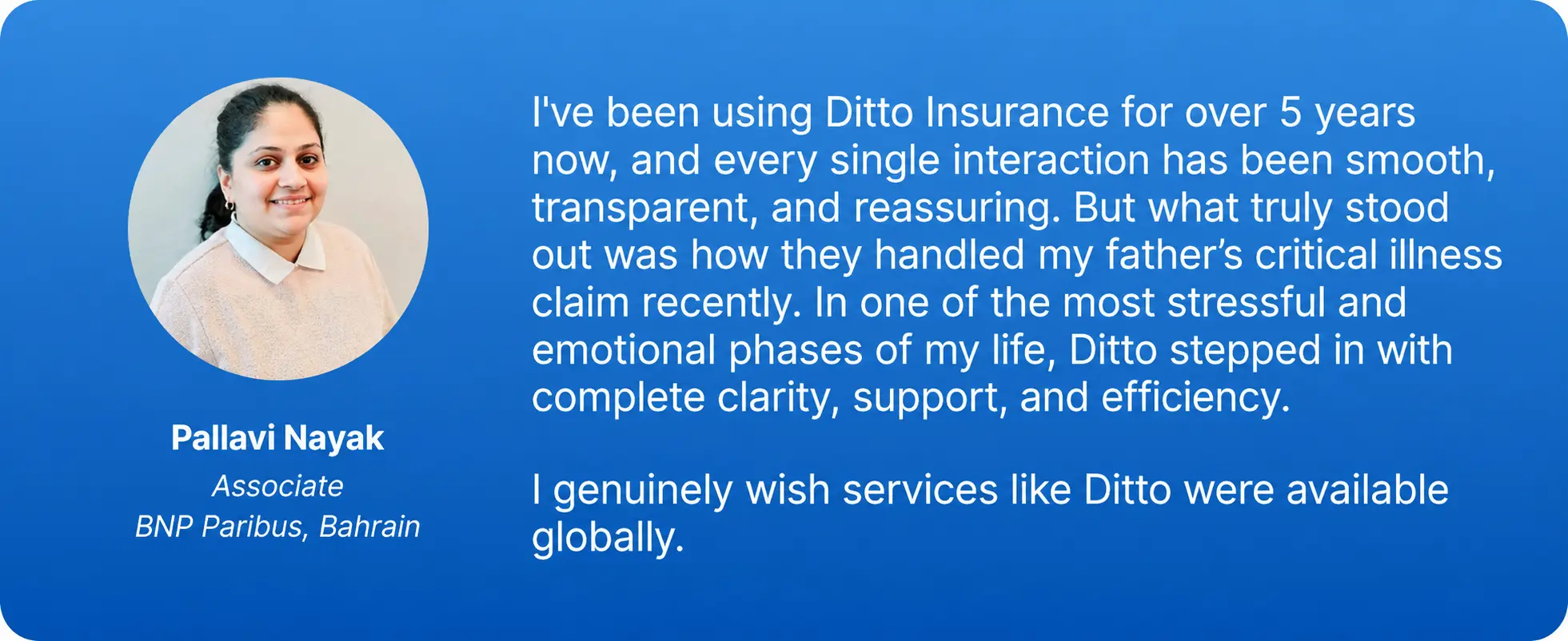
At Ditto, we’ve assisted over 12,00,000 customers choose the right insurance policy. Why customers like Pallavi love us:
100% Free Consultation
No Spam. No Sales Pressure.
Rated 4.9/5 on Google Reviews by 30,000+ Happy Customers
Backed by Zerodha
Dedicated Claim Support Team
Compare Plans and Premiums with a Trusted Insurance Advisor
Confused about the right insurance? Speak to Ditto’s certified advisors for free, unbiased guidance. Book your call now or chat with us on WhatsApp. Slots fill up fast!
Conclusion
Buying health insurance can feel confusing at first, but the decision becomes easier when you break it down.
Start with who needs coverage, how much coverage you need, which hospitals you prefer, and what health conditions must be disclosed.
From there, focus on how the plan will behave during an actual claim. A good policy should protect you from unpleasant surprises later, especially when hospital bills are high, and decisions need to be made quickly.
The right health insurance plan is not always the cheapest or the most feature-packed one. It is the one that fits your age, city, family structure, and medical history. Take your time, compare carefully, and buy a plan you can continue renewing for years.
Disclaimer
We believe in full transparency around our partnerships. Our current insurer partners are HDFC ERGO, Care, Aditya Birla, and Niva Bupa. But as you can see in this list, the rankings include both partners and non-partners because the methodology is unbiased and applied uniformly across all insurers.
Frequently Asked Questions
Which health insurance plan should I consider buying in India in 2026?
No single health insurance plan is best for everyone. The right policy depends on your age, city, family size, medical history, budget, and preferred hospitals. Based on Ditto’s current evaluation framework, plans such as HDFC ERGO Optima Secure+, Care Supreme, and Aditya Birla Activ One MAX are strong options worth considering. Compare features, exclusions, waiting periods, and insurer quality before choosing.
How much health insurance cover is actually enough?
For most individuals and young families, a cover of around ₹15 lakh to ₹25 lakh is a reasonable starting point. You may need more if you live in a metro, prefer premium private hospitals, are older, have existing medical conditions, or are covering several family members. Medical costs can rise quickly, so choosing cover only based on the cheapest premium can leave you underinsured.
Should I add my parents to my family floater or buy them a separate plan?
In most cases, it is better to buy a separate health insurance policy for your parents. Adding older parents to your family floater can increase the premium and means the entire family shares the same sum insured. A large claim by one parent could reduce the cover available for everyone else. Separate policies also make it easier to choose benefits and coverage based on your parents’ specific medical needs.
What documents do I need to buy health insurance online?
You will usually need proof of identity, age, and address for every person being insured. Depending on the insurer, they may accept Aadhaar, PAN, passport, voter ID, or similar documents. You may also need recent medical reports, prescriptions, discharge summaries, or test results if you have an existing health condition. The insurer can ask for additional documents or medical tests during underwriting.
What does the online health insurance buying process look like?
You first compare policies and choose the plan, sum insured, and add-ons you want. You then fill out the proposal form with your personal, lifestyle, and medical details. After you pay the premium, the insurer reviews your application. Depending on your age and health history, it may ask for medical tests or a tele-medical interview. The insurer issues the policy once underwriting is complete and it accepts your application.
Is my employer’s health insurance enough, or do I need a personal plan too?
Employer health insurance is useful, but it should not be your only health cover. The policy is linked to your employment and can change or end when you switch jobs, take a career break, or retire. A personal health insurance policy stays with you regardless of your employer. Buying one early also helps you complete waiting periods while you are younger and generally healthier.
How useful is the claim settlement ratio when choosing a health insurer?
The claim settlement ratio shows the proportion of claims an insurer has settled during a given period. It is useful, but it should not be the only metric you consider. A good insurer should also have a reasonable incurred claims ratio, low complaint volumes, a strong hospital network, and consistent service quality. Looking at multiple years of data gives a better picture than relying on one year alone.
What does the incurred claims ratio tell me about a health insurer?
The incurred claims ratio compares the total value of claims an insurer incurs with the premiums it earns. It helps you understand how much of the insurer’s premium income is going toward claims. A very low or very high ratio can require closer examination. Always consider the ratio alongside claim settlement data, complaints, financial strength, and overall insurer performance.
Why should I avoid health insurance plans with room-rent limits?
A room-rent limit restricts the type or cost of hospital room that your policy will fully cover. If you choose a room above the permitted limit, some policies may reduce not only the room charge but also related hospital expenses through proportionate deductions. This can significantly increase your out-of-pocket cost. Where possible, choose a policy without restrictive room-rent limits.
Is a co-pay clause something I should avoid?
A co-pay clause means you must pay a fixed percentage of every admissible claim from your own pocket. For example, with a 20% co-pay, you would pay ₹1 lakh on a ₹5 lakh admissible claim. This can become expensive during large or repeated hospitalizations. If you have a choice, prefer a policy without mandatory co-pay. Some senior citizen or high-risk plans may still include one.
How does restoration benefit work, and do I really need it?
Restoration benefit refills your sum insured after you use part or all of the original cover, subject to the policy terms. It can be especially useful in a family floater or when there are multiple hospitalizations in the same year. The conditions differ across insurers. Check whether restoration is unlimited, whether it applies to the same illness, and whether the same insured person can use it.
How does a no-claim bonus work in health insurance?
A no-claim bonus rewards you for completing a policy year without making a claim. Depending on the policy, the insurer may increase your sum insured or offer a renewal discount. The benefit can accumulate over several years. You should also check what happens after a claim, because some insurers reduce the accumulated bonus while others allow you to retain part or all of it.
What is the 5-year moratorium period in health insurance?
The moratorium period applies after you complete 60 continuous months of health insurance coverage, including permitted portability or migration. After this period, an insurer generally cannot contest a claim based on past non-disclosure or misrepresentation, except in cases such as proven fraud or permanent exclusions specified in the policy. You should still disclose all medical information truthfully when buying the policy.
Top-up vs. super top-up health insurance: which one makes more sense?
A top-up policy usually starts paying only when a single admissible claim crosses the chosen deductible. A super top-up considers eligible medical expenses cumulatively across the policy year. This makes a super top-up more useful when you have several hospitalizations that stay below the deductible individually but exceed it in total. For most people using it to supplement a base policy, a super top-up is usually more practical.
How much can health insurance cost for a 25-year-old?
The premium for a 25-year-old depends on the city, insurer, sum insured, medical history, and add-ons selected. In the examples used in this guide, a healthy 25-year-old in Delhi could pay roughly ₹11,000 to ₹19,000 a year for ₹25 lakh of cover. These figures are only indicative. Your actual premium can be higher or lower depending on underwriting and the policy you choose.
Do I need critical illness insurance if I already have health insurance?
Regular health insurance and critical illness insurance solve different problems. A health insurance policy pays eligible hospitalization and medical expenses according to its terms. Critical illness insurance pays a fixed lump sum if you are diagnosed with a covered serious illness and meet the policy conditions. You can use the payout for income loss, loan payments, rehabilitation, or other expenses that regular health insurance may not cover.
What health conditions and medical history should I disclose while buying a policy?
Answer every medical and lifestyle question in the proposal form accurately. Disclose existing illnesses, past surgeries, hospitalizations, ongoing or recent medications, investigations, and habits such as smoking or alcohol consumption wherever the insurer asks about them. Do not decide on your own that an old condition is unimportant. Incorrect or incomplete disclosures can affect underwriting and may create problems when you make a claim.
Is maternity coverage worth paying for in a health insurance plan?
Maternity coverage can be useful if you expect to need it and buy the policy well in advance. Most maternity benefits come with a waiting period and may also limit the amount the insurer will pay. Compare the additional premium, waiting period, maternity limit, delivery coverage, newborn benefits, and exclusions. If the expected benefit is small compared with the extra premium, paying for it may not make financial sense.
What should I do during the 30-day free-look period?
Use the free-look period to review the policy you have actually received, not just the brochure or sales explanation. Check your name, age, medical disclosures, sum insured, waiting periods, exclusions, co-pay, room-rent rules, add-ons, and other important terms. If any information is incorrect or the policy differs from what you agreed to buy, contact the insurer immediately and request a correction or cancellation as permitted.
Which documents should I check after my health insurance policy is issued?
Start by checking the policy schedule, proposal form, and Customer Information Sheet. Make sure your name, date of birth, contact details, sum insured, nominee information, and medical disclosures are recorded correctly. Then review the waiting periods, exclusions, room-rent limits, co-pay, sub-limits, and add-ons. If anything is missing or incorrect, ask the insurer to correct it in writing before you need to make a claim.
How quickly should an insurer approve cashless and reimbursement claims?
For cashless treatment, insurers are expected to decide on authorization requests within the regulatory timelines and provide final authorization promptly when the hospital requests discharge approval. Reimbursement claims generally take longer to settle because the insurer must review the submitted documents and may conduct an investigation when required. Always submit complete documents and respond quickly to any additional information the insurer requests.
Customer Reviews
4.9
20915 reviews
Ditto is doing really great. Absolutely spam free- that's the best part. They don't talk to you like they are forced to sell the product. It's more like, helping us buy better. Advisor Nuha was very patient and answered all my questions with clarity. Thanks for the service
I
INDHUMATHI M
Loved the service! Maheta Nidhi Hitesh was incredibly helpful and knowledgeable. She guided me through the whole process and made everything super easy to understand. I really appreciated how patient she was with all my questions—there was no pressure at all, just clear and honest advice. Honestly, I'm very happy with my experience at Ditto so far. Highly recommend!
RK
Ragul Kumar
I had a great experience with Ditto while exploring health insurance options. The process was smooth and everything was explained clearly.
A special thanks to Swaroop SK for patiently answering all my questions and guiding me through the policy details without any pressure. The transparency and support made it much easier to understand and choose the right plan.
Really appreciate the assistance!
PS
Pulkit Singh
Had a great experience with Ditto Insurance. Ishita Sudrania was extremely helpful in guiding me through choosing the right term plan. There was no spamming or sales pressure, and all my questions were patiently answered. She also assisted me thoroughly with the entire application process. Highly recommend!
SS
Samil Shah
I had a great experience with Ditto while filing my health insurance claim. Their team guided me clearly through the entire process, helped with the required documents, and promptly answered all my queries. Their support made the claim process much smoother and less stressful. Highly appreciate their assistance.