

Health Insurance

Niva Bupa vs. Star Health Insurance: Comparison

Ann Tresa Jais

Written by Ann Tresa Jais

Insurance Writer

Gaurav Bhat

Reviewed by Gaurav Bhat

IRDAI-Certified Expert at Ditto

SP0738578124

Certified
Niva Bupa vs. Star Health Insurance: Comparison

Overview

Niva Bupa and Star Health are both standalone health insurers, but they differ on claims, network, and pricing.

Key Comparison

  • Hospital Network: Niva Bupa has 10,000+ cashless hospitals, while Star Health has 14,000+.
  • Premiums: In our comparison, Star Health costs less for younger buyers and families, while Niva Bupa costs less for senior couples.
  • Pre-Hospitalization: Niva Bupa's comprehensive plans cover 60 days before admission, while Star Health's go up to 90 days.
  • Restoration Benefit: Both insurers offer unlimited restoration on their top plans, for the same or a different illness.

Which One Should You Choose?

  • Choose Niva Bupa If: You want an insurer with a higher claim settlement ratio, fewer complaints.
  • Choose Star Health If: You live in a Tier 2 or Tier 3 city where a wider hospital network helps, or you prefer a standalone health insurer with its flexible add-ons.

Confused between Star Health vs. Niva Bupa? Both insurers are well-known players, which can make choosing between them difficult. In this Niva Bupa vs Star Health insurance review, we compare features, premiums, and overall performance to help you decide.

Niva Bupa vs. Star Health: Quick Comparison

About Niva Bupa Health Insurance

    • Founded: 2008 (originally Max Bupa, rebranded as Niva Bupa in 2021)
    • Ownership: Joint venture between the private equity firm True North and the UK-based healthcare giant Bupa
    • Hospital Network: 10,000+ cashless hospitals across India

About Star Health Insurance

    • Founded: 2006
    • Ownership: Founded by V. Jagannathan, and other key investors include WestBridge Capital and other Private Equity (PE) firms
    • Hospital Network: 14,000+ cashless hospitals across India

Key Insight

Star Health is India's largest standalone health insurance company, with a business volume of ₹18,606 crore in FY 2025-26. Its claim settlement ratio has improved every year, reaching 91.05% in FY 2025-26, but its complaints remain nearly double the industry average. It has also faced a customer data breach and disputes over hospital tie-ups in recent years. 

Niva Bupa vs. Star Health: Performance Metrics

MetricsNiva BupaStar HealthIndustry Average
Claim Settlement Ratio (CSR)92.92%88.63%92.02% 
Incurred Claim Ratio (ICR)58.10%67.26%81.88% 
Complaints Received (Per 10,000 Claims)37.1354.0429.35
Gross Written Premium (GWP) / Annual Business - Total Health (in crore)₹6,895.24₹16,859.02₹4,504 

Note: The information mentioned above is sourced from IRDAI Annual Reports, Niva Bupa, and Star Health’s public disclosures. ICR and the industry average are based on FY 2023-25, while the other metrics are updated for FY 2024-26.

Key Insights

    • Claim Settlement: Niva Bupa's higher claim settlement ratio points to more dependable claim processing, and it has improved every year, reaching 94.4% in FY 2025-26. Star Health's three-year average is below our 90% benchmark, though it has also improved steadily, reaching 91.05% in FY 2025-26.
    • Financial Balance: Both insurers sit within the healthy 55% to 85% ICR range, which means both pay a fair share of premiums as claims while staying financially stable.
    • Complaints: Both insurers receive more complaints than the industry average. Niva Bupa's complaints fell to an all-time low of 29.19 per 10,000 claims in FY 2025-26, while Star Health's remain much higher.
    • Business Volume: Star Health runs a much larger operation, with more than twice Niva Bupa's business volume. Niva Bupa is a well-established insurer on a comparatively smaller scale.

Talk to an expert
today and find
the right
insurance for you.

Ditto Advisor

Coverage, Features, and Plan Differences

Niva Bupa health insurance plans include ReAssure 2.0, Aspire, and Health Recharge super top-up. 

Star Health’s portfolio also includes comprehensive health policies, including Star Super Star, Star Comprehensive, and Family Health Optima. 

Let’s compare their flagship plans to see where each one stands out.

FeaturesNiva Bupa ReAssure 2.0Star Health Super Star
Sum Insured (SI) Options ₹5 lakh to ₹1 crore₹5 lakh to unlimited 
Entry Age Adult: 18 years, child: 91 days to 30 yearsAdult: 18 years, child: 91 days to 25 years 
Exit Age No limit Adult: No limit, child: 26 years 
Copayment Not applicable Not applicable 
Room Rent LimitsNo restrictionNo restriction
Disease-Wise Sub-LimitsNot applicable Not applicable 
Pre- and Post-Hospitalization Expenses 60-180 days 90-180 days
AYUSH, Organ Donor Expenses and Domiciliary Treatments Covered up to SICovered up to SI
BonusCarry forward unused SI up to 10x of SI, depending on the variant50% up to 100% of SI for every claim-free year (can be made unlimited with an add-on, irrespective of claims)
RestorationUp to 100%, unlimited times, any illness Up to 100%, unlimited times, any illness 
Consumables Covered through an add-on (Safeguard/Safeguard+)Covered through an add-on (consumables cover)

Features tell you what a plan covers, but premiums determine whether it fits your budget. Both matter when picking the right insurer.

Premium Comparison: Niva Bupa vs. Star Health

ProfilesNiva Bupa ReAssure 2.0 Titanium+Star Health Super Star
Individual Plan (Age 25)₹12,601₹10,662
Family Floater, 2A, Ages (31, 32)₹21,442₹17,858
Family Floater, 2A 1C, Ages (35, 34, 5)₹27,995₹22,930
Senior Citizen, 2A, Ages (62, 63)₹76,064₹82,505

Note: A stands for adult, C stands for child. The premiums are calculated for a ₹15 lakh SI for healthy individuals residing in Delhi (pincode 110010). These numbers may vary based on age, medical history, location, and selected add-ons. 

Premium Analysis: Star Health Super Star is noticeably cheaper across profiles, with the gap widening for family floater plans. If budget is a constraint, Star has the edge, but Niva Bupa's higher premium comes with claim reliability, so you're paying more for greater peace of mind.

Niva Bupa vs. Star Health:Which is Better?

Go With Niva Bupa If You:

    • Prefer an insurer with a higher claim settlement ratio and fewer complaints.
    • Want a higher in-built bonus accumulation, up to 10x of your SI over time.
    • Are a young buyer in a metro city where network hospital access isn't a concern.

Go With Star Health If You:

    • Live in a smaller city where Star's 14,000+ hospital network gives you better cashless access.
    • Want flexibility through add-ons and unlimited SI. 
    • Are looking for budget-friendly family coverage.
    • Have an experienced offline agent helping you navigate through the claim processing. 

Why Choose Ditto for Health Insurance?

At Ditto, we’ve assisted over 12,00,000 customers choose the right insurance policy. Why customers like Pallavi love us:
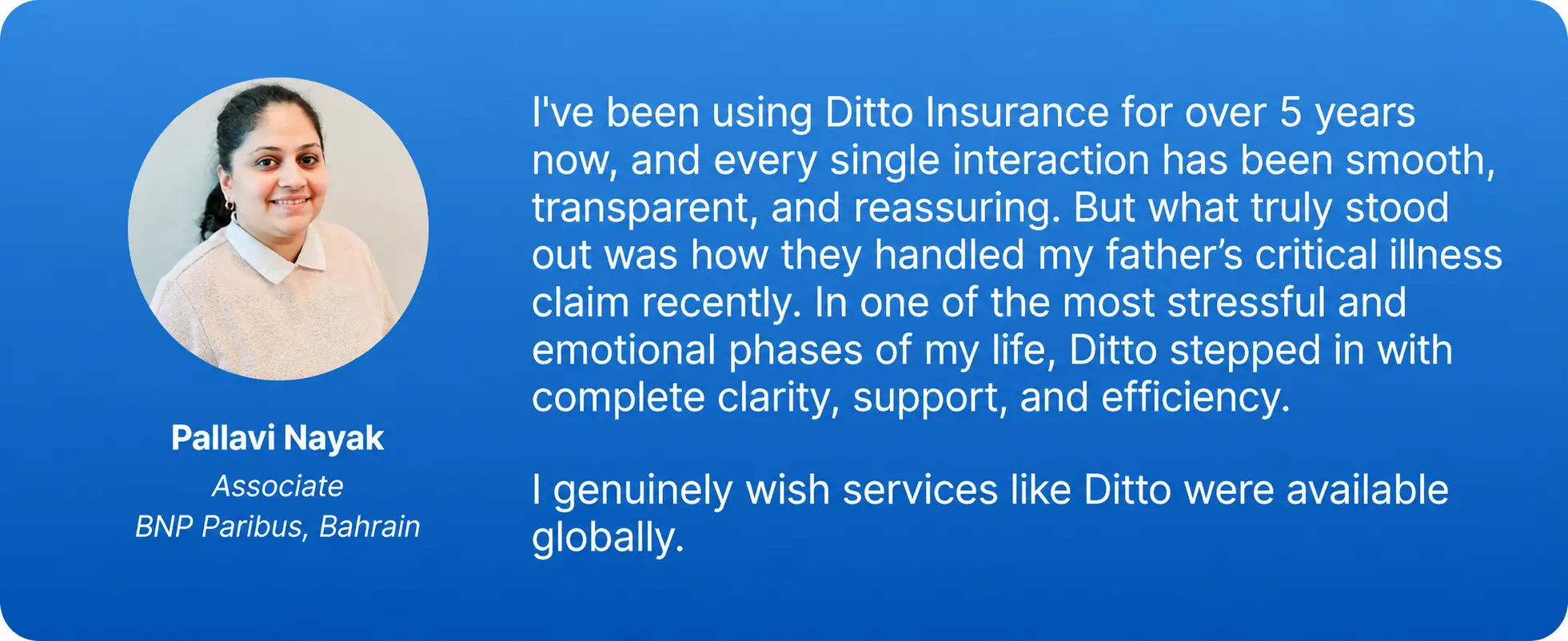
Pallavi Nayak LinkedIn Customer Testimonial
    • 100% Free Consultation
    • No Spam. No Sales Pressure.
    • Rated 4.9/5 on Google Reviews by 30,000+ Happy Customers
    • Backed by Zerodha
    • Dedicated Claim Support Team
    • Compare Plans and Premiums with a Trusted Insurance Advisor

Confused about the right insurance? Speak to Ditto’s certified advisors for free, unbiased guidance. Book your call now or chat with us on WhatsApp. Slots fill up fast!

Conclusion

Niva Bupa and Star Health are both large standalone health insurers, but they're in different places right now. Niva Bupa's ReAssure 2.0 Platinum+ features in Ditto's list of the top 5 health insurance plans in India, and its complaints have fallen to an all-time low. Star Health's claim settlement ratio has improved every year, but its complaints remain high. These facts are worth considering before deciding on any insurer.

If you're set on one of these two, Niva Bupa is the stronger choice, with a higher claim settlement ratio and fewer complaints. But if you're open to alternatives, insurers like HDFC ERGO, CARE Health and Aditya Birla offer even higher claim settlement ratios and lower complaint volumes.

Our Recommendation: Weigh all your options, considering your age, location, budget, and whether you have any pre-existing conditions. Check company metrics, and as a starting point, you can refer to our guide on the best health insurance companies in India.

Frequently Asked Questions

Which is better, Niva Bupa or Star Health Insurance?

It depends on whether you value claim settlement or network size more. Niva Bupa has a higher claim settlement ratio of 92.92%, compared to Star Health's 88.63% (FY 2023-24 to FY 2025-26 average), and receives fewer complaints. Its ReAssure 2.0 Platinum+ also features in Ditto's top 5 health insurance plans. Star Health, on the other hand, has a larger network of 14,000+ cashless hospitals, compared to Niva Bupa's 10,000+, which can help if you live in a Tier 2 or Tier 3 city.

Which is better for families, Niva Bupa or Star Health?

Both insurers offer family floater plans with strong features. Niva Bupa ReAssure 2.0 restores your cover an unlimited number of times in a policy year, up to the sum insured for each claim, which is useful when more than one family member needs hospitalization. Star Health Super Star also offers unlimited automatic restoration, along with optional maternity cover with a 12- or 24-month waiting period. If a smooth claim experience is your priority, Niva Bupa's higher claim settlement ratio and lower complaint volume give it an edge.

Are there better health insurance alternatives to both Niva Bupa and Star Health?

Yes. HDFC ERGO and Aditya Birla have higher claim settlement ratios and fewer complaints than both, at 97.61% with 8.87 complaints per 10,000 claims and 96.25% with 18.67, respectively. Care Health also has a higher claim settlement ratio of 95.45%, though its 42.67 complaints are more than Niva Bupa's (FY 2024-26 averages). In Ditto's top 5 health insurance plans, HDFC ERGO Optima Secure+, Care Supreme, and Aditya Birla Activ One MAX rank ahead of Niva Bupa ReAssure 2.0 Platinum+. 

How does Niva Bupa's Booster+ compare with Star Super Star's cumulative bonus?

Niva Bupa's Booster+ carries forward any unused sum insured to the next year, up to 5x your base cover on ReAssure 2.0 Platinum+ and up to 10x on Titanium+. Star Super Star gives a built-in cumulative bonus of 50% for each claim-free year, capped at 100% of your sum insured. Star also offers an optional Super Star Bonus that adds 100% of your sum insured every year, irrespective of claims, with no upper limit, for an extra premium. So Niva Bupa offers more growth built in, while Star offers higher growth if you pay for the add-on.

What are the main concerns with Star Health Insurance?

Star Health is India's largest standalone health insurer, with a business volume of ₹18,606 crore in FY 2025-26. Its claim settlement ratio has improved every year, reaching 91.05% in FY 2025-26, but its three-year average of 88.63% is still below the industry average of 92.02%. Its complaints are the main concern, averaging 54.04 per 10,000 claims, well above the industry average of 29.35. The insurer has also faced a customer data breach and disputes with hospitals over cashless tie-ups in recent years.

Is Niva Bupa the same as Max Bupa?

Yes. Max Bupa Health Insurance was rebranded as Niva Bupa in 2021. Today, UK-based healthcare company Bupa is its majority shareholder, and Niva Bupa is listed on the stock exchanges. Existing policies and the hospital network continued after the rebrand. Niva Bupa's service record has also improved in recent years, with complaints falling to an all-time low of 29.19 per 10,000 claims in FY 2025-26.

What is Lock the Clock in Niva Bupa, and does Star Health offer something similar?

Lock the Clock is available on Niva Bupa ReAssure 2.0 Platinum+ and Titanium+. It charges your premium based on the age at which you joined until a claim is paid. After that, premiums follow your current age at renewal. It locks your age, not your price, so company-wide repricing can still raise premiums. Star Super Star offers a similar benefit called Freeze Your Age, which is available if you join at age 50 or younger, and lasts until a claim is made or you turn 56.

Can I port from Star Health to Niva Bupa?

Yes, you can port your existing health insurance from Star Health to Niva Bupa under IRDAI’s portability guidelines. Porting allows you to transfer your accrued benefits, such as the waiting periods for pre-existing diseases and the moratorium period, to the new insurer.

To begin the process, you must apply to Niva Bupa at least 45 days before your Star Health policy expires. Given Niva Bupa’s higher claim settlement ratio of 91.62%, many policyholders choose to port to seek better service reliability despite Star Health’s larger hospital network and dominant market presence.

Last updated on: