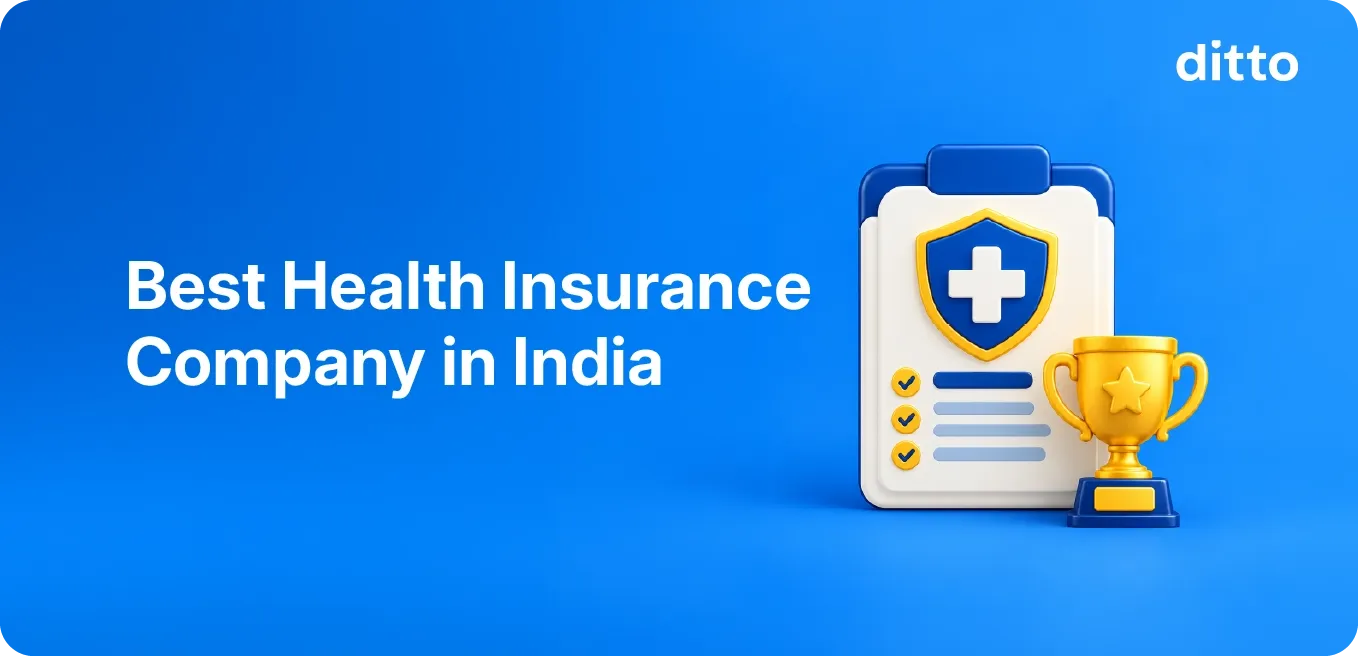
The best health insurance companies in India are evaluated based on their Claim Settlement Ratios (CSR), complaint volumes, hospital networks, and financial strength. According to Ditto's insurer ratings, the top companies include:
HDFC ERGO: Scores 4.85/5, with a 97.61% CSR and 16,000+ network hospitals.
Bajaj General: Scores 4.85/5, with a 95.63% CSR and very low complaint volume.
Aditya Birla Health: Scores 4.70/5, offering customizable plans and 16,500+ network hospitals.
Care Health: Scores 4.25/5, with competitively priced plans and extensive coverage options.
Niva Bupa: Scores 4.20/5, with features like Lock the Clock and unlimited restoration benefits.
What to Check Before Choosing
Claim Performance: Look for a CSR above 90% and relatively low complaint volumes.
Hospital Network: Check whether your preferred hospitals offer cashless treatment.
Policy Features: Compare waiting periods, room rent limits, co-payments, exclusions, and premiums before deciding.
Imagine you're buying your first health insurance plan. You search online and find more than 30 insurers, each promising hassle-free claims, extensive hospital networks, and affordable premiums.
On paper, they all sound great. But how do you figure out which insurer will actually stand by you when a hospital bill comes up?
Well, choosing the best health insurance company in India isn't just about picking a popular brand or the cheapest plan. You also need to look at how reliably an insurer settles claims, how many complaints it receives, how strong its hospital network is, and whether it is financially stable.
Fortunately, most of this information is publicly available, making it easier to compare insurers beyond their marketing claims.
In this guide, we compare India's top health insurance companies using key operational metrics, plans, and pros and cons to help you choose an insurer that best suits your needs.
Need help finding the best health insurance company for yourself? Book a free call or chat on WhatsApp with Ditto’s IRDAI-certified advisors.
Ditto’s Score: Top 10 Health Insurance Companies in India
How Does Ditto Choose the Best Health Insurance Companies in India?
At Ditto, we evaluate health insurance companies using a transparent, data-driven insurer rating framework. Each insurer receives a score out of 5, based on six weighted parameters according to their relative importance.
Claim Settlement Ratio (30%)
Complaint Volume per 10,000 Claims (25%)
Gross Written Premium (15%)
Hospital Network (10%)
Claims Model (10%)
Online Services (10%)
We also consider other indicators, such as the Incurred Claims Ratio (ICR), when evaluating insurers. You can refer to Ditto Data Lab for the underlying data, and we update scores as new regulatory public disclosures become available.
Prefer watching over reading? We've put together a video comparing the best health insurance companies in India.
Talk to an expert today and find the right insurance for you.
Detailed Overview: Top Health Insurance Companies in India
HDFC ERGO General Insurance was established in 2002 and is a joint venture between HDFC Bank Group and ERGO International. Over the years, it has expanded its presence in the Indian general insurance market, particularly in health insurance. Its acquisition and subsequent merger with Apollo Munich Health Insurance strengthened the insurer’s health insurance portfolio.
Bajaj General Insurance began operations in 2001 as Bajaj Allianz General Insurance, a joint venture between the Bajaj Group and Germany's Allianz SE. Following changes in its ownership structure, the company was rebranded as Bajaj General Insurance. It offers health, motor, travel, and other general insurance products.
Aditya Birla Health Insurance began operations in 2016 as a joint venture between Aditya Birla Capital and South Africa's MMI Holdings. As a standalone health insurer, it focuses primarily on health insurance and wellness-related products.
Strong claim settlement performance and relatively low complaint volume.
Extensive cashless hospital network and an in-house claims settlement process.
Exponential business growth over the past few years.
Highly customizable plans with optional benefits like maternity coverage, doctor consultations, wellness rewards (HealthReturns), and international treatment.
Cons:
Relatively smaller health insurance business compared to established insurers such as HDFC ERGO, making it important to consider the insurer’s long-term performance as it scales.
Care Health Insurance was established in 2012 as Religare Health Insurance and was subsequently rebranded as Care Health Insurance. It operates as a standalone health insurer, offering policies for individuals, families, senior citizens, and people with complex medical conditions.
Niva Bupa Health Insurance was originally established as Max Bupa, a joint venture involving Max India and the UK's Bupa Group. The company began operations in 2010 and adopted the Niva Bupa name in 2021. It subsequently became a publicly listed company in 2024. As a standalone health insurer, Niva Bupa focuses on individual and family health insurance.
SBI General Insurance began operations in 2009 and is backed by the State Bank of India, one of India's largest banking institutions. The company offers a wide range of general insurance products, including health, motor, travel, and home insurance.
Generali Central Insurance was established in 2006 as Future Generali India Insurance, a joint venture between the Future Group and Italy's Generali Group. After the Central Bank of India acquired a stake in the company in 2025, the insurer rebranded as Generali Central Insurance. It offers health, motor, travel, and other general insurance products, including individual and family health policies.
Generali Central Insurance
3.9
Overall Rating
Claim Settlement Ratio
4.0/5
Network Hospital
4.0/5
Customer Service
4.0/5
Annual Business Volume
2.0/5
Flagship Plans: Health Xtra, Health Unlimited, DIY Health, and Health PowHer
Pros:
Good claim settlement record and relatively low complaint volume.
In-house claims settlement process.
Cons:
Relatively limited brand recognition and lower health insurance business volumes than leading insurers.
Recent ownership and management changes make its long-term performance under the new structure an important factor to monitor.
Oriental Insurance was established in 1947, making it one of India's oldest general insurance companies. It operated as a subsidiary of the Life Insurance Corporation of India (LIC) from 1956 to 1973 and later became part of the public sector general insurance framework. Today, the Government of India owns it, and the insurer offers health, motor, property, and other general insurance products.
Government-owned insurer with several decades of experience.
A strong claim-settlement record along with substantial business volumes.
Cons:
Several plans have not kept pace with newer comprehensive policies. Depending on the product, customers may encounter room rent restrictions, disease-wise sub-limits, limited restoration benefits, and modest cumulative bonuses.
Heavy reliance on TPAs for claims processing can add coordination and potential delays.
Digital policy management and self-service facilities can be less convenient than those offered by leading private insurers.
ACKO General Insurance was founded in 2016 and began operations in 2017 as a digital-first general insurer. Unlike traditional insurers, ACKO primarily follows a direct-to-customer model, allowing customers to buy and manage policies online. Although it initially focused on motor and other general insurance products, it has subsequently expanded into health insurance with policies designed around simplified coverage and digital servicing.
Strong claim-settlement track record and relatively low complaint volume.
Decent cashless hospital network.
Certain plans offer comprehensive features, such as no standard initial waiting period, reduced or waived pre-existing disease waiting periods, and high coverage limits, subject to underwriting and policy conditions.
Digital-first approach simplifies policy purchases, renewals, and online servicing.
Cons:
Relatively new to retail health insurance, with a smaller business scale than established competitors. Its long-term claims performance at scale is therefore less established.
Reliance on outsourced claims processing or Third-Party Administrators (TPAs) can add coordination complexity during claims.
Aggressively priced premiums could be revised as the insurer's claims experience develops.
Its direct distribution model means customers generally depend on the insurer's own support channels rather than an agent for assistance.
Universal Sompo General Insurance began operations in 2007 as a joint venture involving Indian Bank, Indian Overseas Bank, Karnataka Bank, Dabur Investment Corporation, and Japan's Sompo Insurance Group. The company offers a range of general insurance products, including health, motor, property, and travel insurance.
Decent claim settlement performance and relatively low complaint volume.
In-house claims settlement process.
Comprehensive health insurance plans with optional maternity and OPD coverage.
Competitive premiums compared to several established standalone health insurers.
Cons:
Relatively limited brand recognition and smaller health insurance business volumes, making its long-term performance at a larger scale less established.
List of Health Insurance Companies in India
Insurer
Type
Branches
Solvency Ratio (Average FY 2024-26)
Claim Settlement Ratio (CSR) (Average FY 2024-26)
Incurred Claims Ratio (ICR) (Average FY 2023-25)
Volume of Complaints per 10,000 Claims (Average FY 2024-26)
Network Hospitals
Annual Business Volume - Total Health (In Crore) (Average FY 2024-26)
Cashless Pre-Authorization Decision Within 2 Hours (%)
Cashless Pre-Authorization Decision Within 2 Hours (%): Higher is better. It shows the percentage of cashless pre-authorization requests on which the insurer decides within 2 hours. However, this does not mean all those requests were approved.
Cashless Discharge Decision Within 2 Hours (%): Higher is better. It indicates the percentage of cashless discharge decisions made within 2 hours, helping you understand how quickly an insurer processes discharge requests.
IRDAI's prescribed decision timeline is one hour for pre-authorization and three hours for final discharge authorization.
Outstanding Claims Over 3 Months (%): Lower is better. A lower percentage means fewer claims have remained pending for more than 3 months, which is generally a positive sign for claims processing.
The cashless pre-authorization and discharge percentages refer to in-house claims processing.
Galaxy Health and Narayana Health have only two years of CSR data, covering FY 2024-25 and FY 2025-26.
Why Does Comparing Medical Insurance Companies Matter in India?
Two health insurance companies may offer similar-looking plans, but your experience with each can differ, especially when it comes to claims and coverage. Comparing insurers beforehand helps you identify these differences and avoid unpleasant surprises when you need your policy the most.
01
Claim Experiences Can Differ Across Insurers
Insurers differ in how consistently and efficiently they settle claims. Comparing claim settlement ratios can help you assess an insurer's reliability and understand what to expect when filing a claim.
02
Frequent Complaints Can Point to Service Problems
Complaint volumes can indicate recurring issues with claim settlements, customer support, or policy servicing. Comparing complaints per 10,000 claims helps you understand how insurers perform relative to the number of claims they handle.
03
Access to Cashless Treatment Varies Across Insurers
Every insurer has a different network of hospitals where cashless treatment is available. Comparing hospital networks helps you check whether reputable hospitals near your home, frequently traveled places, or your family's location are covered.
04
Similar Premiums Can Offer Very Different Coverage
Health insurance premiums can vary considerably even for plans with the same sum insured. Comparing premiums alongside room rent limits, waiting periods, co-payments, and other policy conditions helps you assess whether a plan offers good value for money.
05
Financial Stability Matters for Long-Term Coverage
Health insurance is a long-term commitment, and you may remain with the same insurer for decades. Comparing an insurer's financial strength, claims performance, and service track record helps you assess its ability to meet policyholder obligations over time.
06
Switching Insurers Later Isn't Always Simple
You can port your health insurance policy to another insurer while retaining eligible waiting period credits. However, the new insurer may reassess your health and apply its underwriting criteria, so choose a suitable insurer from the start.
In short, comparing insurers is the best safety net before you actually buy insurance.
How to Choose the Best Health Insurance Company Based on Your Needs?
1) Assess Your Medical Needs
Do you or a family member have an ongoing condition like diabetes, high blood pressure, or thyroid issues? If yes, the Pre-Existing Disease (PED) waiting period is the single most important thing to check. Most plans make you wait 2 to 3 years before they cover these conditions, while some insurers offer ways to shorten that waiting period.
2) Check Features and Plans
An insurer can have a great track record, but the plan you buy determines what you get when you file a claim. Look for:
No Restrictions: Choose plans with no co-payment, room rent limit, or disease-wise sub-limits.
Consumables Cover: Choose plans that cover consumables like gloves, masks, and syringes by default or as an add-on, since they can make up 5% to 15% of the hospital bill.
Restoration and Bonus: Look for plans that restore your Sum Insured (SI) after each claim and grow your SI after each renewal, irrespective of claims.
3) Understand Your Family Structure
The right plan type depends on who you are covering.
Individual Plans: They work well for single buyers, senior citizens, or people with pre-existing conditions. Each person has their own sum insured, and one member's claim doesn't affect another's cover.
Family Floater Plans: These can work well for households with children. One sum insured is shared by everyone, which is more cost-effective.
4) Check Performance Metrics
This is where the insurer's report card comes in. At Ditto, we recommend checking that the insurer has:
A CSR of 90% or higher
An ICR in the 55% to 85% range
At least 10,000 network hospitals, including the ones near you
Fewer than 20 complaints per 10,000 claims for general insurers and less than 40 for SAHI
A solvency ratio comfortably above the IRDAI minimum of 1.5x
We explain each of these in detail in the next section.
5) Get Expert Advice
Comparing 30+ insurers and hundreds of plans is a lot to take on alone. An unbiased advisory platform can shortlist plans for you and help with claims after you buy. At Ditto, our advisors are IRDAI-certified, consultations are free, and there is no spam or pressure to buy.
Factors Affecting Mediclaim Insurance Companies in India
1) Claim Settlement Ratio (CSR)
Meaning: The number of claims an insurer settles out of the total number of claims it receives. Imagine 100 people file claims and the insurer settles 97. That is a 97% CSR.
Ideal Range: Above 90%. A CSR below 85% signals that you should be more careful.
Industry Average: 92.02% (FY 2024-26).
Keep in Mind: The claim settlement ratio of health insurance companies tells you how many claims were paid, not how much of each bill was covered. It also doesn't guarantee your claim will be paid. Think of it as a useful signal, not a promise.
2) Complaints per 10,000 Claims
Meaning: How many customer complaints an insurer receives for every 10,000 claims it handles. Imagine 10,000 families file claims. If 4 of them complain, that is a very good sign. If 100 people complain, something is going wrong in the process.
Ideal Range: Below 20 for general insurers and below 40 for standalone health insurers.
Industry Average: 29.35 (FY 2024-26).
Why it Matters: Complaints show how it felt to get the claim paid, or not. The complaints metric can also signal delays, poor communication, and disputes.
3) Incurred Claims Ratio (ICR)
Meaning: The share of premiums an insurer pays back as claims. Imagine an insurer collects ₹100 in premiums over the year and pays out ₹80 in claims. Its ICR is 80%.
Ideal Range: 55% to 85%.
Industry Average: 81.88% (FY 2023-25).
How to Read It:
Too High (Above 85%): The insurer is consistently paying out almost everything it earns. That can strain its finances and may lead to higher premiums at renewal.
Too Low (Below 50%): It may suggest that the insurer is strict when approving claims.
In the Middle: A healthy balance between collecting premiums and paying out claims.
4) Network Hospitals
Meaning: The number of hospitals where you can get cashless treatment, meaning the insurer pays the hospital directly and you don't need to pay upfront.
Ideal Range: At least 10,000 network hospitals, and the hospitals you would actually use should be on the list.
Keep in Mind: A big number is not enough. Check if the hospitals near your home, your parents' home, and your workplace are included. Most insurers let you search their network list on their website before you buy.
5) Solvency Ratio
Meaning: A measure of whether an insurer has enough money set aside to pay its long-term claims and obligations. Think of it like an emergency fund. It is calculated as the available solvency margin divided by the required solvency margin.
Minimum Required: IRDAI mandates a minimum of 1.5x (150%).
Ideal Range: There is no single magic number. A ratio just above 1.5 meets the rule. But it is safer to pick insurers that stay comfortably above 1.5 year after year. At the same time, a very high number alone does not tell the full story, since an unusually high ratio can mean capital is sitting idle. Look at it alongside CSR and complaints.
Where the Industry Stands: As of March 31, 2026, all private general and standalone health insurers met the 1.5 minimum. Three public sector general insurers were below zero: National Insurance, Oriental Insurance, and United India, which is fairly concerning.
Real-World Example
In 2019, Reliance Health Insurance's solvency ratio fell from 106% in June to 63% in September, well below IRDAI's required 150%. Consequently, IRDAI ordered the insurer to stop selling new policies and transfer its existing health insurance portfolio to Reliance General Insurance, effective November 15, 2019, to safeguard policyholders’ interests. This shows why an insurer's financial strength matters.
6) Gross Written Premium (GWP)
Meaning: The total premium an insurer collects before sharing any with reinsurers. For health insurance, we use the premium collected from the total health segment (which includes health, personal accident, critical illness, travel, etc.).
Ideal Scale: More than ₹2,500 crore.
Industry Average: ₹4,504 crore (FY 2024-26).
Why it Matters: A larger premium base usually means more customers, more claims data, established systems, processes, and more financial strength to absorb a bad year.
Keep in Mind: Size is not everything. A large insurer with poor complaint numbers is still a poor choice. Use GWP as a tie-breaker, not as the first filter.
7) Claims Model (TPA or In-House)
Meaning: A Third-Party Administrator (TPA) is an IRDAI-licensed company that some insurers use to process claims. Other insurers handle claims with their own in-house teams.
Why it Matters: When an insurer relies on TPAs, your claim passes through more hands. That can lead to inconsistent experiences because the insurer does not fully control the process. Insurers with their own claims teams tend to be more consistent.
8) Online Services
Meaning: Whether you can buy, renew, track claims, and download documents online without visiting a branch.
Why it Matters: Good digital access saves time, especially during a hospital stay when your family is stressed.
9) Age and Track Record of the Insurer
Meaning: How long an insurer has been operating and its experience handling insurance claims.
Ideal Range: There is no fixed benchmark, but insurers with a longer and consistent track record, usually over 10 years, are generally preferable.
Why it Matters: Established insurers like Oriental Insurance (1947) and HDFC ERGO (2002) have a longer operating history, making it easier to assess their claims performance and financial stability.
Keep in Mind: Newer insurers like Aditya Birla Health (2016) and ACKO (2016) may also perform well, but have a shorter track record. Compare their claim settlement ratios, complaints, and financial strength before deciding.
Why Choose Ditto for Health Insurance?
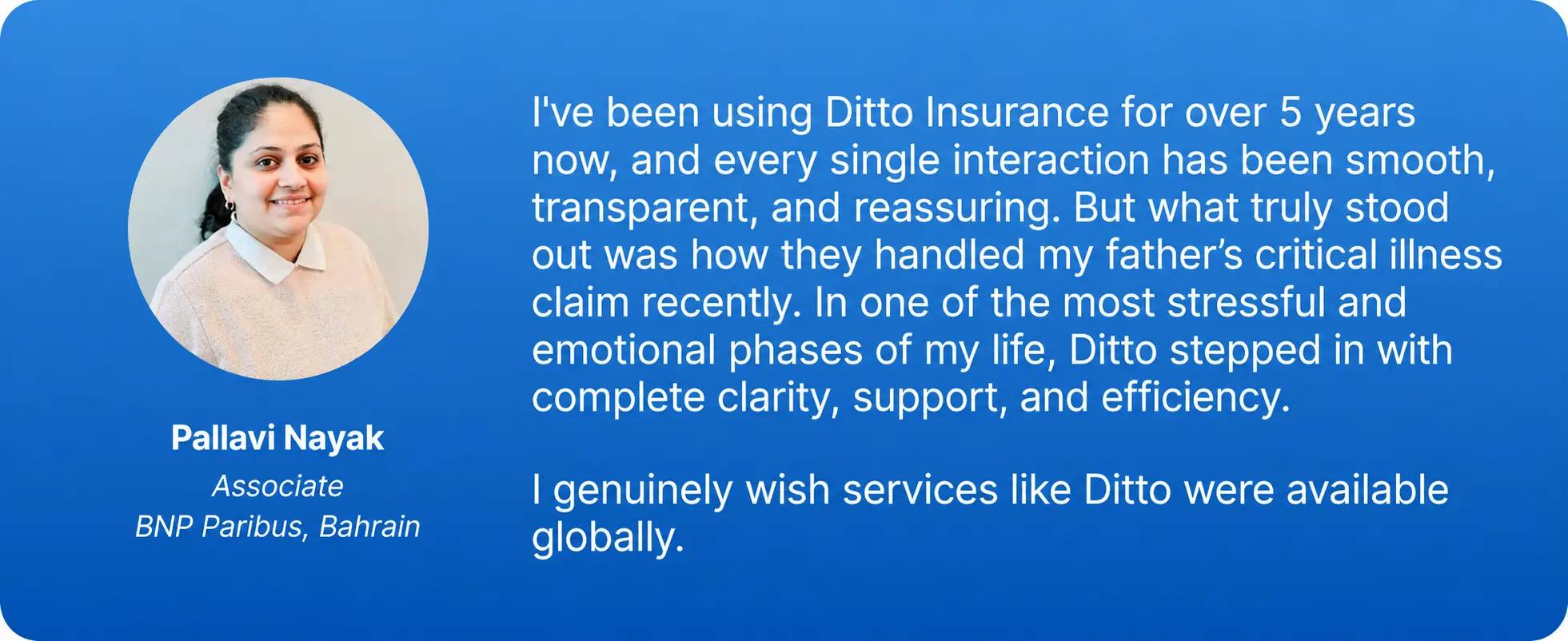
At Ditto, we’ve assisted over 12,00,000 customers with choosing the right insurance policy. Why customers like Pallavi love us:
100% Free Consultation
No Spam. No Sales Pressure.
Rated 4.9/5 on Google Reviews by 30,000+ Happy Customers
Backed by Zerodha
Dedicated Claim Support Team
Compare Plans and Premiums with a Trusted Insurance Advisor
Confused about the right insurance? Speak to Ditto’s certified advisors for free, unbiased guidance. Book your call now or chat with us on WhatsApp. Slots fill up fast!
Ditto’s Take
So, which is the best health insurance company in India? Honestly, there is no single answer, but there is a way to find the best insurer for you.
Here is how to move ahead:
List Your Needs: Write down your age, family members, any pre-existing conditions, your city, and your budget.
Shortlist 3 Insurers: Pick those with a CSR above 90% and fewer complaints per 10,000 claims.
Check Your Hospitals: Search each insurer's network list for the hospitals you would actually use and look for insurers with 10,000+ network hospitals.
Compare Plans: Look at waiting periods, room rent rules, restoration, sub-limits, and add-ons for the exact plan.
Compare Premiums: Use the same sum insured and the same members for every quote.
Read the Policy Wording. Pay special attention to exclusions and waiting periods.
Disclose Your Medical History: While applying, share your past and existing medical conditions, medications, surgeries, consultations, and other relevant details as accurately and completely as possible to avoid claim disputes later.
And if comparing all these factors feels overwhelming, you can always speak to an expert. Ditto's advisors can help you compare insurers and choose a suitable plan with unbiased advice, completely free of charge, along with lifetime claims support (if bought through us).
Disclaimer
Ditto is an IRDAI-registered corporate agent and works with select insurance companies. However, our rankings and comparisons include both partner and non-partner insurers, which are evaluated using the same rating framework.
For partner insurers, we also consider Ditto's own claims experience, while assessments of non-partner insurers rely on regulatory disclosures and other verified information.
Frequently Asked Questions
Which is the #1 health insurance in India?
According to Ditto's ranking, Bajaj General and HDFC ERGO share the top position, each scoring 4.85/5. Bajaj General has a 95.63% Claim Settlement Ratio (CSR) and just 3.85 complaints per 10,000 claims. HDFC ERGO has a higher CSR of 97.61% and a network of over 16,000 hospitals. However, the best insurer for you also depends on your medical needs, preferred hospitals, budget, and the features of the policy you choose.
What is the best health insurance company in India as per claim settlement?
Among established players, Go Digit has the highest three-year average CSR at 99.01%, followed by New India Assurance (98.00%) and HDFC ERGO (97.61%), based on FY 2024-26 data. However, CSR only measures the number of claims settled. It doesn't tell you whether claims were paid in full or how smoothly they were processed. So, consider complaint volume, hospital network, and policy coverage alongside CSR before choosing an insurer.
Which health insurance company has a 100% claim settlement ratio?
Narayana Health reported a 100% claim settlement ratio in FY 2024-25 and 103.24% in FY 2025-26, resulting in a two-year average of 101.62%. However, Ditto's CSR ranking excludes Narayana due to unresolved discrepancies in its reported data. Also, a 100% CSR doesn't guarantee that every future claim will be approved. Claim settlement figures depend on the reporting period and calculation method. We recommend comparing an insurer's performance over at least three years before deciding.
Is a high claim settlement ratio enough to choose the best health insurance company?
No. A high CSR is important, but it doesn't tell you everything about an insurer's claim handling or customer service. For example, Bajaj General has a CSR of 95.63% and 3.85 complaints per 10,000 claims, while Care Health has a similar CSR of 95.45% but 42.67 complaints per 10,000 claims. This is why you should also evaluate complaint volume, incurred claims ratio, solvency, cashless hospital network, and policy features before choosing an insurer.
Which health insurance companies in India have the most complaints or the lowest claim settlement ratio?
Based on three-year averages from FY 2024-26, Navi General reports the highest complaint volume at 220.47 per 10,000 claims, followed by Raheja QBE (67.87) and Star Health (54.04). Navi General also has the lowest CSR at 79.82%, followed by Cholamandalam MS at 84.16%. Galaxy Health reports 84.78%, although this is based on only two years of data. Consider these figures alongside each insurer's claim volumes, business scale, and financial strength.
How to choose the best health insurance company in India?
Start by assessing your age, medical history, family size, and budget. Then shortlist insurers with a CSR above 90%, a solvency ratio above 1.5, and preferably at least 10,000 network hospitals. For complaint volumes, Ditto prefers fewer than 20 per 10,000 claims for general insurers and fewer than 40 for standalone health insurers. Next, compare policies for room rent restrictions, co-payments, waiting periods, restoration benefits, and exclusions. Finally, check premiums for the same sum insured and confirm that your preferred hospitals offer cashless treatment.
Which one should I choose between standalone health insurers and general insurers?
Both can be good choices, depending on the insurer's performance and the policy you select. Standalone health insurers, such as Care Health, Aditya Birla, and Niva Bupa, specialize in health insurance and often offer plans for specific medical conditions. General insurers, such as HDFC ERGO, Bajaj General, and SBI General, provide health insurance alongside other insurance products. At Ditto, we recommend comparing insurers based on claim settlement records, complaint volumes, hospital networks, and policy features rather than choosing solely by category.
What are the top 5 health insurance companies in India?
According to Ditto's insurer ratings, the top 5 health insurance companies in India are HDFC ERGO (4.85/5), Bajaj General (4.85/5), Aditya Birla Health (4.70/5), Care Health (4.25/5), and Niva Bupa (4.20/5). These rankings consider claim settlement ratios, complaint volumes, business scale, hospital networks, and claims processing. However, the best choice for you depends on your medical needs, budget, preferred hospitals, and the coverage offered by each insurer's plans.
What are the top 5 govt health insurance companies in India?
If you're looking for the top 5 govt health insurance companies in India, only four public-sector insurers offer health insurance: New India Assurance, National Insurance, Oriental Insurance, and United India Insurance. Among these, New India Assurance has the highest three-year average CSR at 98%, followed by United India at 95.03%. However, government ownership doesn't automatically guarantee better coverage or claim service. Several public-sector insurers face financial pressures. National, Oriental, and United India report negative average solvency ratios, while all four have relatively high ICRs. Compare each insurer's financial strength, hospital network, claim settlement record, and policy features before choosing.
Is SBI General a government health insurance company?
No. SBI General Insurance is classified as a private-sector general insurer, even though it is backed by the State Bank of India (SBI), a government-controlled bank. The Ministry of Finance lists SBI General under private-sector insurers, separate from the four public-sector general insurance companies. So, if you're considering an SBI General health plan, evaluate the insurer based on its claim-settlement record, complaints, solvency, hospital network, and policy features. The SBI name alone doesn't make it a public-sector insurance company.
Is choosing the best health insurance company enough to get the right coverage?
Choosing a reliable insurer is a good start, but the policy must suit your medical history, budget, and coverage needs. Before buying, compare waiting periods, exclusions, co-payments, and preferred hospitals. Also disclose your medical history as accurately and completely as possible during the application process to avoid claim disputes later. At Ditto, our advisors help you compare suitable plans, understand underwriting conditions, and complete your application. For policies purchased through us, we also provide lifetime post-sales and claims support, including assistance with renewals, portability, and claims.
Have any health insurance companies faced regulatory action from IRDAI recently?
Yes. In August 2026, IRDAI warned ACKO General and Niva Bupa for exceeding management expense limits and restricted them from opening new business locations for six months. It also directed Star Health to review certain portability-related claims and report compliance within four months. In September 2026, IRDAI fined ICICI Lombard ₹1 crore for outsourcing-related regulatory violations. These actions don't automatically suspend existing policies or claim processing. However, buyers should consider regulatory history alongside claims performance, financial strength, and policy benefits.
Are new health insurance companies entering the Indian market, and should you consider them?
Yes. Narayana Health Insurance and Galaxy Health Insurance introduced their first products in 2024, while Prudential HCL Health Insurance began operations in August 2026. New insurers can offer different policy features and competitive premiums. However, they have limited historical data on claim settlement, complaints, and customer service compared to established insurers. Before choosing one, carefully evaluate its policy benefits, underwriting terms, hospital network, and claims process. A promising plan is worth considering, but its long-term servicing reliability remains to be established.
Customer Reviews
4.9
20915 reviews
Ditto is doing really great. Absolutely spam free- that's the best part. They don't talk to you like they are forced to sell the product. It's more like, helping us buy better. Advisor Nuha was very patient and answered all my questions with clarity. Thanks for the service
I
INDHUMATHI M
Loved the service! Maheta Nidhi Hitesh was incredibly helpful and knowledgeable. She guided me through the whole process and made everything super easy to understand. I really appreciated how patient she was with all my questions—there was no pressure at all, just clear and honest advice. Honestly, I'm very happy with my experience at Ditto so far. Highly recommend!
RK
Ragul Kumar
I had a great experience with Ditto while exploring health insurance options. The process was smooth and everything was explained clearly.
A special thanks to Swaroop SK for patiently answering all my questions and guiding me through the policy details without any pressure. The transparency and support made it much easier to understand and choose the right plan.
Really appreciate the assistance!
PS
Pulkit Singh
Had a great experience with Ditto Insurance. Ishita Sudrania was extremely helpful in guiding me through choosing the right term plan. There was no spamming or sales pressure, and all my questions were patiently answered. She also assisted me thoroughly with the entire application process. Highly recommend!
SS
Samil Shah
I had a great experience with Ditto while filing my health insurance claim. Their team guided me clearly through the entire process, helped with the required documents, and promptly answered all my queries. Their support made the claim process much smoother and less stressful. Highly appreciate their assistance.