



If something happened to you tomorrow, would your family’s finances continue smoothly, or would everything suddenly feel uncertain?
When you strip it down, term insurance benefits are simple; if you’re not around tomorrow, your family still has the money they need to get through.
A lot of people hesitate here.
“If I survive, I get nothing.” “I already have investments.” “My company gives me insurance.”
But they miss the point. You don’t call car insurance a waste because you didn’t crash. And investments, while important, are built for goals, not sudden risks. They may be too small early on, poorly timed, or hard to liquidate when your family needs money the most. Employer cover, on the other hand, is limited and tied to your job; it’s not something you fully control.
In this guide, we break down the term insurance benefits that actually matter, from income replacement and loan protection to tax advantages and riders, so you can make a clear, confident decision without second-guessing.
What is Term Insurance?
Term insurance is the simplest form of life insurance. You pay a fixed premium for a fixed tenure, and if you pass away during that period, your nominee receives a pre-defined payout.
There’s no investment component. No maturity benefit in most cases. And no savings angle. That’s exactly why term insurance benefits stand out. You’re not mixing insurance with returns, you’re buying pure protection.
Because of this structure, the benefits of term insurance include very high coverage at surprisingly low premiums. A ₹1 crore cover can cost less than a few thousand rupees a month if you buy early.
Think of it this way: term insurance is designed for a low-probability but high-impact event. Ideally, you never need it. But if something does happen, your family won’t have to scramble, there’s money ready when they need it.
Once you buy it, your premium is locked for the entire tenure. It only becomes expensive if you delay the purchase.
That’s the core idea behind term life insurance benefits: simple, predictable, and built for the one situation where financial clarity matters the most.
When people search for term insurance benefits, they’re really asking one thing: how will this help my family when I am not around?

Term Insurance Benefits
Income Replacement & Financial Continuity
The most important of all term insurance benefits is income replacement. Your family depends on your future earnings, and term insurance ensures that income is replaced instantly, so they can maintain their lifestyle without financial disruption.
Debt Protection & Financial Dignity
Among the most practical benefits of term life insurance is debt protection. A clean payout helps your family repay loans without selling assets in distress, borrowing, or depending on others, preserving financial stability and dignity.
High Coverage at Low Cost
One of the strongest term life insurance benefits is financial leverage. Term plans offer significantly higher coverage for a relatively low premium. This makes term insurance far more cost-efficient than traditional life insurance products, like endowment plans or ULIPs.
Immediate Liquidity & Flexible Payouts
A key part of term insurance benefits is immediate access to funds. Nominees can receive payouts as a lump sum, an income stream, or both, ensuring money is available when it’s needed most without complex decisions.
Locked Premiums & Early Purchase Advantage
Among the long-term benefits of term insurance is premium certainty. Once issued, premiums remain fixed for the entire policy term (unless there are any changes in GST). Buying early helps lock in lower premiums and secure coverage before health risks increase.
Tax Benefits Under 80C and 10(10D)
Important term insurance tax benefits include deductions (up to ₹1.5 lakh) under Section 80C (Old Regime) and tax-free payouts under Section 10(10D). These term life insurance tax benefits improve overall financial efficiency while securing your family.
Term Insurance Benefits by IRDAI
First and foremost, it’s important to lock down a sufficient sum assured and policy term for your term insurance plan. Since the ideal sum assured is highly subjective and depends on your income, lifestyle, loans, liabilities, etc., we are not in a position to give you an absolute number. Instead, you can use this term insurance cover calculator to calculate your required coverage. As for the policy term, 65-70 is a good age range to be taking term insurance till. This is because most of your financial responsibilities dissipate by then, and your income also stops, so paying premiums may become difficult.
Now that the most essential elements have been discussed, let’s come to the next thing of importance. Riders.
Key Riders In Term Insurance
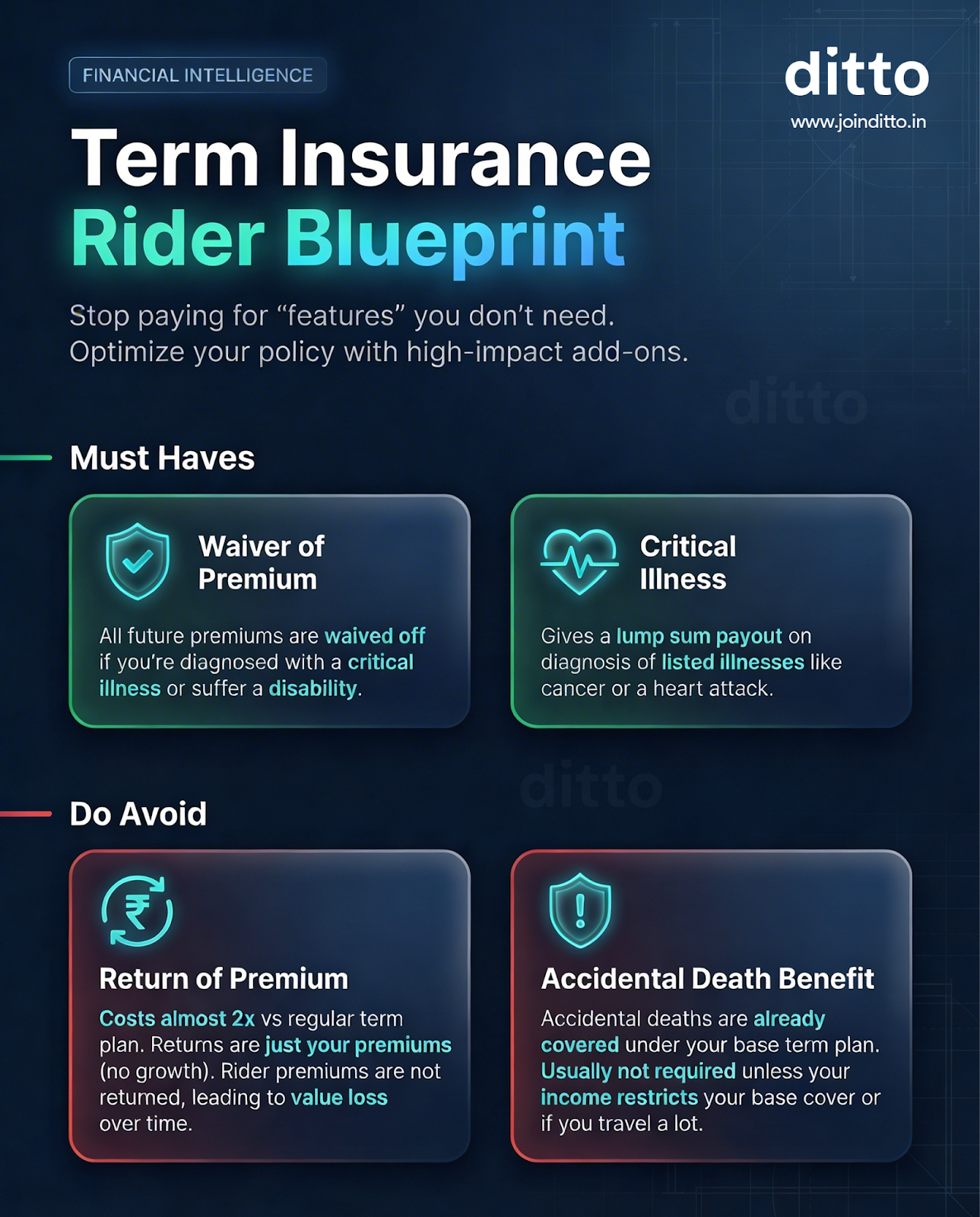
Riders are additional benefits that you can tether to your term insurance plan for an additional premium amount, to boost coverage in ways that are meaningful to you. Before reading the details, let’s look at the infographic below to understand what really matters.
Waiver of Premium (WOP) Rider
A Waiver of Premium rider ensures that if you suffer a defined disability or listed critical illness, all future premiums are waived while your life cover continues without interruption, protecting your policy during periods of income disruption.
Critical Illness (CI) Rider
A Critical Illness (CI) rider provides a lump sum on diagnosis of specified illnesses, helping cover income loss and recovery costs beyond health insurance. It complements, not replaces, health cover. Insurers may restrict or decline CI riders for pre-existing conditions like hypertension or high cholesterol, and issuance can be delayed if medical records are incomplete or not disclosed properly.
Accidental Total and Permanent Disability (ATPD) Rider
An Accidental Total and Permanent Disability rider pays out if an accident results in permanent disability, ensuring financial support even when death does not occur, but earning capacity is impacted.
Accidental Death Benefit (ADB) Rider
An Accidental Death Benefit rider offers an additional payout in case of death within 180 days of an accident; however, since the base term policy already covers death from any cause, its incremental value may be limited.
Features To Look For In Term Insurance
Understanding term insurance riders is step one. Choosing a plan with the right in-built features is step two. When evaluating the benefits of term insurance, look for the following:
- A terminal illness benefit provides an accelerated payout, either a portion or up to a specified cap, if the policyholder is diagnosed with a medically certified terminal condition, subject to policy terms and definitions, ensuring timely access to funds during a critical phase.
- A life-stage upgrade option enables you to increase your sum assured during major milestones such as marriage or childbirth, usually without fresh underwriting, helping your coverage grow with responsibilities.
- A top-up or cover enhancement option allows you to increase coverage later by adding additional sum assured, though it may require fresh underwriting and revised premiums based on age and health for the increased portion.
- An instant claim payout feature allows insurers to release a partial amount immediately upon claim intimation and document submission, improving short-term liquidity for the family before the full claim is processed.
- A premium break / auto-continuance of cover feature allows you to defer premiums (typically for up to a year) under specific conditions while keeping your term cover active, reducing the risk of policy lapse during financial strain or disruptions.
- An early exit or zero-cost option allows you to exit the policy after a defined period and receive back base premiums paid; however, this feature may come with higher premiums due to the longer cover tenure requirements.
- Health Management Services (HMS) provides access to wellness benefits such as teleconsultations, wellness sessions ,or preventive health check-ups, adding limited but practical value to overall term life insurance benefits.
- Free medical check-ups during application are often included as part of the underwriting process, where the insurer bears the cost of required tests such as blood work, ECG, or other diagnostics. While not guaranteed in every case (some insurers may use virtual assessments for low-risk applicants), this can provide added value by offering a basic health screening at no additional expense.
Talk to an expert
today and
find
the right
insurance for you.


How to Choose the Best Life Insurer
When evaluating term insurance benefits, the insurer’s strength matters as much as the policy features. Here’s what you should assess:
- Claim Settlement Ratio (CSR): Look at the 3-year (long-term) average CSR to understand what percentage of claims the insurer settles, rather than relying on a single year’s number. You can read our guide on the top ten term insurers ranked by CSR.
- Amount Settlement Ratio (ASR): This shows the proportion of total claim amount paid versus total claim amount received, offering deeper insight into whether large claims are being honoured on par with small ones.
- Solvency Ratio: This measures the insurer’s financial strength and ability to meet long-term claim liabilities. In India, the regulatory minimum solvency requirement for life insurers is 1.5x, so insurers should maintain a ratio above this threshold.
- Complaint Volume: Review the number of complaints per 10,000 claims to gauge service quality and post-sales support standards.
- Annual Business Volumes: Strong and consistent annual premium collections indicate operational stability, market trust, and long-term presence.
- Underwriting Philosophy: A disciplined underwriting process may feel strict during application, but it improves long-term claim reliability and reduces future disputes.
Top 5 Term Insurance Plans
Disclaimer: These recommendations are based on Ditto’s six-point product evaluation framework (product quality, claims experience, underwriting transparency, flexibility, affordability, and operational reliability) and our three-point insurer assessment (financial strength, claims track record, and service reliability). These criteria help ensure that the plans recommended here strike the right balance between protection, claims confidence, and long-term service quality.
Sample Premiums of Some of Our Term Insurance Recommendations
Profile Considered: Premiums are based on a ₹2 crore sum assured, with coverage up to age 70, for a non-smoking male, with no added riders or 1st year or online discounts. Also, the above-mentioned premiums are illustrative in nature and can vary based on age, medical history, and insurer underwriting.
When people look at term insurance benefits, it’s equally important to understand where term plans may fall short, so you can make a well-informed decision.
Drawbacks of Term Insurance
No Returns or Wealth Creation
Pure term insurance plans do not offer any maturity benefit or investment returns. If you outlive the policy term, no payout is made, as the plan is designed purely for financial protection and not for savings or wealth creation.
Premiums Increase with Age
Premiums rise significantly as you grow older. Delaying your purchase can make the same coverage much more expensive, especially if health conditions develop over time.
Underwriting & Eligibility Constraints
Medical underwriting is mandatory. Pre-existing conditions can lead to higher premiums, exclusions, restricted coverage, or even rejection. In some cases, policy issuance may also be delayed due to documentation gaps or reinsurer review.
Rider Limitations & Cost Impact
Riders like Critical Illness or disability benefits come with specific definitions and conditions, which may limit payouts. Some add-ons, such as accidental death benefit or return-of-premium options, can increase premiums and reduce overall cost efficiency.
Claim Dependency on Disclosure
Claim approval depends heavily on accurate disclosure at the time of purchase. Any non-disclosure or misrepresentation can lead to disputes or rejection during claim settlement.
Documentation & Medical Requirements
Policy issuance may take time if required documents are not submitted promptly. Medical tests may also be required based on your profile, age, or sum assured, adding to the overall process timeline.
So, is it still worth it?
Despite these drawbacks, term insurance benefits remain unmatched when it comes to pure financial protection. The ability to secure a large cover at a low cost, ensure immediate liquidity, and protect your family’s future far outweighs the limitations.
If your goal is protection, not returns, term insurance still does the job better than any other life insurance product.
Why Choose Ditto for Term Insurance?
At Ditto, we’ve assisted over 8,00,000 customers with choosing the right insurance policy. Why customers like Vijay below love us:

- No-Spam & No Salesmen
- Rated 4.9/5 on Google Reviews by 15,000+ happy customers
- Backed by Zerodha
- Dedicated Claim Support Team
- 100% Free Consultation
Confused about the right term insurance? Speak to Ditto’s certified advisors for free, unbiased guidance. Book your call or WhatsApp us now, slots fill up fast!
Ditto’s Take
If there’s one thing we firmly believe at Ditto, it’s this: term insurance is the most effective life insurance product available today.
The reason is simple. Term insurance benefits provide unmatched financial leverage. For the same premium you would pay in a traditional savings-oriented life policy, term insurance can offer nearly 800 to 1000 times more coverage per rupee. That difference is transformational.
When people explore term insurance benefits, they often compare them with endowment plans or ULIPs. But the benefits of term insurance are fundamentally different. Term plans focus purely on protection. No hidden investment component. No diluted coverage. No trade-offs between returns and safety.
That purity is its strength.
The core term life insurance benefit is income replacement, loan protection, tax efficiency, and fixed premiums, which make it the most rational way to protect your family’s financial future. If your goal is to ensure that your loved ones are financially secure regardless of what happens to you, term insurance benefits do that better than any other life insurance product.
We don’t believe in mixing insurance and investment. We believe in separating protection and wealth creation.
Buy term for protection. Invest separately for growth. That’s how you unlock the true benefits of term life insurance.
Disclaimer
Frequently Asked Questions
Why People Trust Ditto
Last updated on: