




Overview
Most Indians end up under-insuring themselves, either by picking a random number like ₹1 crore or by depending on outdated rules of thumb. When inflation pushes monthly expenses from ₹40,000 to nearly ₹1 lakh over 15 to 20 years, even a “big” cover can fall short.
At Ditto, our advisors speak to numerous customers every month about choosing the right term plan, and a recurring problem we see is people miscalculating the ideal sum assured.
In this guide, we will help you understand the actual term coverage you need using proven, industry-accepted methods.

Why Choosing the Right Term Insurance Cover Matters
Protects Your Family’s Lifestyle
The right term cover ensures your family can continue meeting everyday expenses even if you are no longer around. This includes rent, groceries, school fees, EMIs, and healthcare costs.
Helps Clear Loans and Liabilities
If you have a home loan, car loan, or personal loan, the cover should be large enough to repay these debts. This prevents your family from carrying the burden of EMIs later.
Accounts for Future Goals
Your term cover should include future expenses such as children’s education, marriage, or care for dependent parents. These goals can be expensive, so they should not be ignored while calculating cover.
Protects Against Inflation
Inflation reduces the value of money over time. A well-calculated cover ensures your family’s future expenses are accounted for, not just today’s costs.
Gives Peace of Mind
When the cover amount is right, you know your family has a strong financial safety net. This makes term insurance more useful than simply buying a random cover amount like ₹50 lakh or ₹1 crore.
Talk to an expert
today and
find
the right
insurance for you.


Methods to Calculate How Much Term Insurance You Need
Income-Based Method (HLV + Income Replacement)
This method combines the logic of Human Life Value (HLV) and Income Replacement to calculate term insurance coverage.
Formula: Annual income × number of working years left
Example: If you earn ₹10 lakh annually and plan to work for the next 30 years,
₹10 lakh × 30 = ₹3 crore term insurance coverage
Benefit: If you’re the sole or primary earner in the family, calculating coverage through this method ensures your family continues to live comfortably, even in your absence.
Drawback: This method doesn’t account for increments, job changes, or even starting your own business. Moreover, insurers may limit it to 25x your annual income due to underwriting rules.
Expense and Liabilities Replacement Method
This method adds up all future financial needs, such as monthly expenses, children’s education, marriage, your spouse’s retirement (adjusted for inflation), and other outstanding liabilities, such as home, education, or personal loans.
Formula: Total future expenses + Outstanding liabilities = Cover required
Benefit: This method ensures you're neither under- nor over-insured since it's based on your actual life goals.
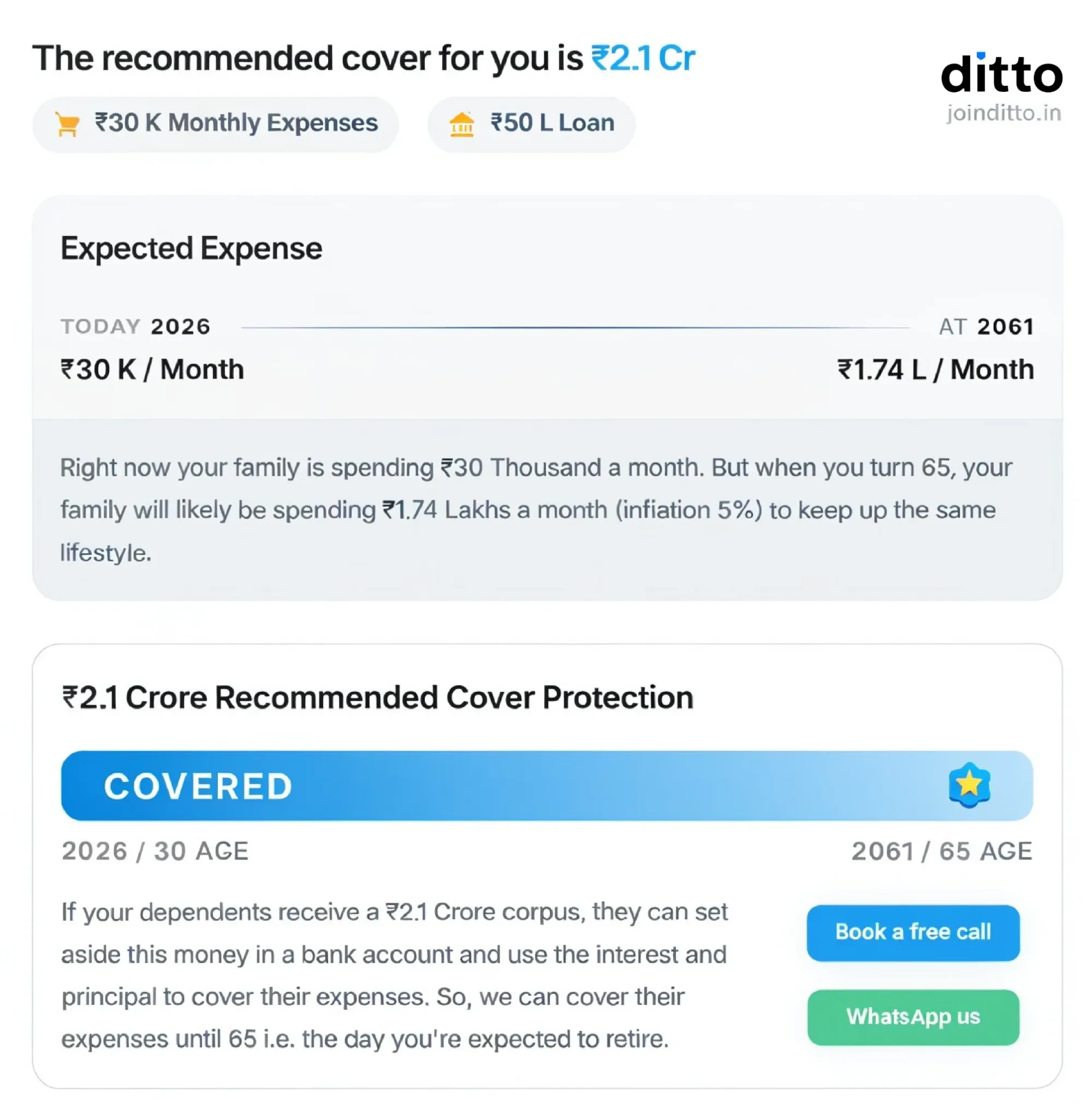
At Ditto, we use the expense and liabilities replacement method to estimate the term cover you require. To get a better understanding, use our term insurance calculator or talk to our certified experts to precisely know the ideal cover for you.
The following snippet includes the term insurance coverage calculation for a 30-year-old individual with ₹30,000 monthly expenses and a ₹50 lakh home loan, seeking coverage up to 65 years.
Worked out your ideal cover? Good. Now find out what it costs — Ditto's term insurance premium calculator compares HDFC, Axis Max Life, ICICI and Bajaj Life in seconds.
Underwriter’s Rule
It’s a general thumb rule based on insurers’ internal underwriting and risk management policies. It usually suggests a maximum cover of around 10 to 25 times your annual income.
Example:
- If you earn ₹10 lakh a year, the term cover should be somewhere between ₹1 crore and ₹2.5 crore.
- If you’re younger and have more financial goals ahead, aim for the higher end (20x to 25x).
- If you are older and already have wealth or fewer responsibilities, the lower end may suffice (10x to 20x).
Benefit: While it’s not foolproof, the underwriter’s rule gives you a quick estimate when you're short on time or just starting your planning journey. In most cases, it is prudent to take the maximum coverage the insurer offers based on this rule and lock in the premium early. However, make sure you declare all existing personal life insurance policies and exclude their sum assured while calculating the additional cover you need.
There may also be cases where the cover you actually need is higher than what your current income allows you to buy. In such situations, opt for the maximum cover you are eligible for today and reassess your coverage as your income increases.
Key Factors That Affect Your Term Insurance Coverage Amount
- Number of Dependents: A single earner supporting a spouse, two children, and aging parents needs significantly more coverage than someone with no dependents. Each dependent adds to both the income-replacement and the expenses component of your calculation.
- Outstanding Loans: Every rupee of outstanding unsecured debt is a liability your family inherits. Your home loan balance in particular should be added directly to your coverage requirement, since a lapsed EMI can put the burden over your family at risk.
- Existing Life Cover: If your employer provides group term insurance, it counts, but do not rely on it entirely. Group cover lapses when you change jobs and typically offers 2 to 5 times your salary, well below what most families need.
- Inflation: Your term cover should be reviewed regularly as your income, liabilities, and family responsibilities change. Buying term insurance once is not enough. Major life events may require increasing your cover to keep your family adequately protected.
- Age, Education, and Health: Insurers have underwriting limits on coverage multiples based on your age, education, and income. Younger, healthier applicants and graduates typically get access to higher multiples, which is another reason to buy early and buy enough the first time.
Did You Know?
Common Mistakes to Avoid When Deciding Your Term Cover
Choosing Too Little Coverage
Relying Only on Thumb Rules
Counting Group Insurance as the Primary Cover
Choosing a Short Policy Term
Why Choose Ditto for Term Insurance?
At Ditto, we’ve assisted over 8,00,000 customers with choosing the right insurance policy. Why customers like Aaron below love us:

- No-Spam & No Salesmen
- Rated 4.9/5 on Google Reviews by 15,000+ happy customers
- Backed by Zerodha
- Dedicated Claim Support Team
- 100% Free Consultation
You can book a FREE consultation. Slots are running out, so make sure you book a call or chat on WhatsApp now!
Conclusion
Before you lock in your term insurance cover, there are a few personal factors that deserve a closer look.
- If you’re in your 20s or early 30s, you can choose a longer tenure and get higher coverage at a lower premium.
- Your coverage should increase with the total number of people relying on your income, such as your spouse, young children, or aging parents.
- Consider whether your income is stable or likely to grow, and choose slightly higher coverage now to stay future-ready.
- If you are planning to borrow soon (e.g., via loans and liabilities), make a provision for it in your term cover early.
- Health conditions, smoking, or family illness history can raise premiums or affect eligibility, so getting a policy early and maintaining a healthy lifestyle helps you lock in better rates.
Various methods suggest an ideal cover range of ₹1 crore to ₹2.5 crore, balancing affordability with long-term financial protection. While this may sound sufficient, many families could still fall short over time. Instead of relying on guesswork, use methods like HLV, the Underwriter’s Rule, or the Expense Replacement Method to estimate the right cover, ideally with guidance from a trusted advisor.
Frequently Asked Questions
Last updated on: