



Overview
Accidents can strike anyone at any time, bringing unexpected medical bills, lost income, and long recovery periods. Protecting yourself financially is crucial, and personal accident insurance can help cover these risks.
This guide explains how it works, its benefits, and the best ways to buy coverage, helping you make informed decisions for your safety and peace of mind.
Types of Personal Accident Insurance
Note: Most health insurance plans cover accidental hospitalization and related treatments from day one. A personal accident rider is primarily meant to provide an additional lump sum or income payout to help with lifestyle adjustments and income loss following disability.
Health Insurance Plans With Personal Accident Add-on
- HDFC ERGO Optima Secure+: The plan offers individual personal accident add-on. For the proposer, Optima Secure+ provides a lump sum benefit of up to 500% of the sum insured in the event of accidental death, total permanent disability or permanent partial disability, subject to a maximum benefit of ₹1 crore. The plan is also among the best health insurance plans in India.
- ICICI Lombard Elevate: The plan offers personal accident cover at an additional cost. Under ICICI Lombard Elevate, the proposer can receive a lump sum benefit of up to 100% of the sum insured for accidental death, total permanent disability or permanent partial disability, subject to a maximum benefit of ₹50 lakh.
- Manipal Cigna ProHealth Prime Advantage: Under Manipal Cigna ProHealth Prime Advantage, a lump sum benefit of up to 200% of the sum insured is payable for accidental death or permanent partial disability, subject to a maximum benefit of ₹50 lakh.
Annual Premiums for Personal Accident Insurance
Take Note:
- The listed health premiums are for Niva Bupa Reassure 2.0 Platinum for a 25-year-old, residing in Delhi, for a sum insured of ₹15 lakh. The premiums include the Safeguard and personal accident add-on.
- The listed premiums for New India Personal Accident Insurance are for a 25-year-old.
- The listed term premiums for the HDFC term plan are for a non-smoker profile, male with a sum assured of ₹ 2 crore (Coverage till age 70, without first year discounts). The premiums include an income benefit rider.
Features of Personal Accident Insurance
1. Accidental Death Benefit: Pays 100% of the sum insured as a lump sum if death occurs due to an accident. The payout goes to the nominee and is tax-free under Section 10 (10D) of the Income Tax Act, 1961.
2. Permanent Total Disability (PTD): Offers up to 100% payout if the accident leads to total and irreversible disability, such as loss of both limbs or total blindness. The disability must meet the insurer’s definition and usually occur within 12 months of the accident.
3. Permanent Partial Disability (PPD): Provides a percentage-based payout depending on the severity of the injury, such as loss of one hand or a finger. Each insurer follows a predefined benefit schedule.
4. Temporary Total Disability (TTD): Pays weekly compensation, typically a fixed percentage of the sum insured, if the insured cannot work temporarily due to an accident.
5. Hospitalization Cover: Some plans cover accident-related medical expenses, including ambulance and day-care procedures, subject to policy terms and sub-limits. Unlike traditional health insurance, personal accident insurance does not cover hospitalization costs per se. Instead, the insurer releases a fixed payout if certain conditions are fulfilled. This is why it is classified as a non-indemnity insurance policy.
Talk to an expert
today and
find
the right
insurance for you.
Difference Between Personal Accident Insurance Policy And Term Insurance
Benefits and Drawbacks of Personal Accident Insurance
Note: Personal accident insurance alone usually does not qualify for tax deductions. However, if included as part of a health insurance plan, you may claim benefits under Section 80D of the Income Tax Act in the old tax regime. No deductions apply under the new regime.
What is the Claim Process for Personal Accident Insurance?
Filing a personal accident insurance claim can be stressful after an accident. Knowing the process in advance ensures a smoother experience. Here’s a step-by-step guide:
1. Immediate Notification: Inform your insurer or agent as soon as possible, ideally within 24–48 hours of the accident. Early reporting helps avoid delays or claim rejection.
2. Document Submission: Submit all required documents to support your claim, which usually include:
- Filled in claim form
- Medical reports and hospital records detailing the injury or treatment
- Police or accident report, if applicable
- Death certificate for accidental death claims
- Proof of identity and policy documents
3. Claim Assessment: The insurer reviews all submitted documents and may request additional information or a medical examination to verify the claim.
4. Approval and Payout After verification, the claim is approved. Payouts vary based on claim type:
- Lump sum for accidental death or permanent total disability
- Periodic payments for temporary total disability or partial disability
5. Follow-up: Maintain communication with the insurer, respond promptly to queries, and provide additional documents if requested to avoid delays in claim processing.
Why Choose Ditto for Your Health Insurance?
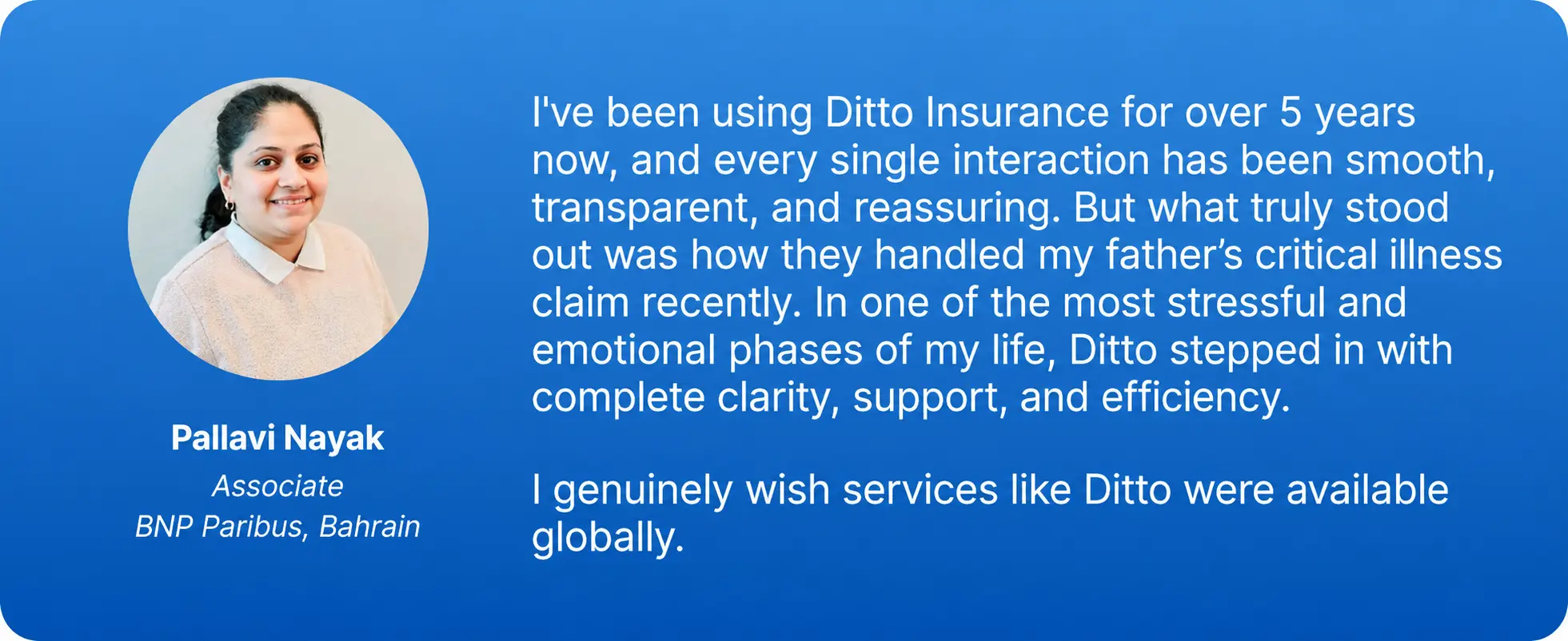
At Ditto, we’ve assisted over 12,00,000 customers choose the right insurance policy. Why customers like Pallavi love us:
- 100% Free Consultation
- No Spam. No Sales Pressure.
- Rated 4.9/5 on Google Reviews by 30,000+ Happy Customers
- Backed by Zerodha
- Dedicated Claim Support Team
- Compare Plans and Premiums with a Trusted Insurance Advisor
Confused about the right insurance? Speak to Ditto’s certified advisors for free, unbiased guidance. Book your call now or chat with us on WhatsApp. Slots fill up fast!
Ditto’s Take on Personal Accident Insurance
Personal accident insurance is essential if your job or lifestyle exposes you to higher accident risk, such as frequent travel, hazardous work, or active sports.
If your concern is hospitalization due to accidents, a comprehensive health insurance policy already covers accident-related medical expenses without waiting periods.
On the other hand, adding a personal accident rider to your term plan is a smarter choice in most cases. Term riders are usually cost-effective, and premiums stay fixed once locked in. For most people, a strong term plan with relevant riders, along with good health insurance, is sufficient without needing a separate standalone personal accident policy.
Disclaimer: Please note that Ditto works with select partner insurers. You can learn more about how we evaluate and recommend plans through Ditto’s cut, where we explain our selection framework transparently.
Currently, Ditto assists customers only with personal retail term insurance and health insurance plans. Standalone personal accident insurance policies are not part of our offerings or advisory services at this time.
Frequently Asked Questions
Last updated on: