Section 80D of the Income Tax Act, 1961, helps you reduce taxable income through deductions on health insurance premiums, preventive health check-ups, and certain medical expenses for senior citizens.
If you are filing under the Old Tax Regime, maximize your deductions for your family and parents, since this can raise your total deduction to ₹1,00,000 a year. At Ditto, we assess Section 80D using five filters: who is covered, age slab, eligible expenses, payment mode, and tax regime eligibility. A 32-year-old in Bengaluru paying ₹22,000 for self-coverage and ₹48,000 for a senior-citizen parent can claim ₹70,000.
This guide is for salaried employees, self-employed taxpayers, and families comparing the ₹25,000, ₹50,000, and ₹5,000 limits before filing their Income Tax Return (ITR).
IRDAI's annual report shows that only 58 crore Indians are covered by some form of health insurance. However, only 6 crore of them hold individually purchased policies. And a big reason for this is that people don't see the full financial value of a health insurance plan. Section 80D under the Old Tax Regime changes that math. It's one of the few tax provisions where the government directly rewards you for protecting your health.
In this guide, we cover key things you need to know about Section 80D, such as limits, eligible expenses, and how to claim your deduction.
Want to understand how your health insurance premiums qualify for tax deductions? Book a free call or chat on WhatsApp with a Ditto advisor.
What Is Section 80D of the Income Tax Act?
Section 80D is a provision under the Income Tax Act, 1961, that allows individuals and Hindu Undivided Families (HUFs) to claim deductions. For individuals, the deduction extends to yourself, your spouse, your dependent children, and your parents.
The deduction under Section 80D directly reduces your taxable income. If you earn ₹10 lakh a year and claim a ₹25,000 deduction, you're taxed on ₹9,75,000 instead. Simple.
Is Section 80D Allowed in New Tax Regime?
No. The deduction under Section 80D is not available if you opt for the New Tax Regime under Section 115BAC. This is because most Chapter VI-A deductions, including deductions like 80C, 80D, and 80G, are not allowed under the new regime. Only limited deductions such as 80CCD(2), 80CCH, and 80JJAA are permitted, as per the Income Tax Department.
Chapter VI-A mainly covers deductions that help reduce your taxable income. If you're evaluating which regime to pick, and you're paying significantly high health insurance premiums, the Section 80D deduction can meaningfully reduce your taxable income.
Section 80D Deduction Limits
The deduction limit depends on the age of the people covered. There are two separate blocks: The first one covers you, your spouse, and your dependent children. The second block covers your parents.
Who Is Covered
Age of Insured
Deduction Limit
Self, Spouse, Dependent Children
Below 60
Up to ₹25,000
Self, Spouse, Dependent Children (Senior Citizen)
60 or above
Up to ₹50,000
Parents
Below 60
Up to ₹25,000
Parents (Senior Citizens)
60 or above
Up to ₹50,000
Both blocks (self + parents)
Below 60 for all
Up to ₹50,000
Self + Parents (One Senior Citizen)
60 or above for one
Up to ₹75,000
Self + Parents (Both Senior Citizens)
60 or above for both
Up to ₹1,00,000
Note: The senior-citizen threshold applies if even one person in a block is 60 years or older during a financial year.
Talk to an expert today and find the right insurance for you.
Expenses Eligible for Deduction Under Section 80D
1) Health Insurance Premiums
This is the primary expense most people claim. It covers individual policies, family floater plans, super top-up plans, critical illness policies, and any other type of health insurance for which you paid the premiums.
2) Preventive Health Check-Ups
You can claim up to ₹5,000 per year for preventive health check-ups. This covers general body check-up packages, blood tests, scans, and routine diagnostics for yourself, your spouse, your dependent children, and your parents.
Two important points here:
The ₹5,000 amount is a sub-limit within your overall block limit, not an additional deduction on top of it.
This is the only exception where cash payment is allowed.
If you paid ₹22,000 in health insurance premiums and ₹3,000 for a full body check-up, your total Section 80D deduction will be ₹25,000 (the block limit).
3) Medical Expenses for Uninsured Senior Citizens
This is helpful if your parent is a resident senior citizen (60+) and has no active health insurance of any kind (including employer-provided group coverage, private, or government). The deductions help you claim actual medical expenses paid for them, up to ₹50,000.
This provision exists because many elderly people are either refused insurance due to existing medical history or face premiums so high that buying a policy isn't practical. The deduction works as a substitute for the premium deduction in such cases.
Mode of Payments Allowed Under Section 80D of Income Tax Act
Expense Type
Allowed Payment Modes
Cash Allowed?
Health Insurance Premiums
Cheque, Demand Draft, Debit/Credit Card, UPI, Net Banking, Bank Transfer
No
Preventive Health Check-Ups
Any mode, including cash
Yes (up to ₹5,000)
Medical Expenses for Senior Citizens
Cheque, Demand Draft, Bank Transfer, Digital Modes
No
Examples of Section 80D Deductions
Self Only, Below 60 A 34-year-old individual pays ₹20,000 in health insurance premiums and ₹4,000 for a preventive check-up. Total spend = ₹24,000. His Section 80D deduction = ₹24,000 (within the ₹25,000 limit).
Self (Below 60) + Senior Citizen Parents A 38-year-old individual pays ₹22,000 for their policy and ₹57,000 for the parents' policy (both parents are 65+). Deduction: ₹22,000 (Block 1, capped at ₹25,000 limit) + ₹50,000 (Block 2, within ₹50,000 senior limit) = ₹72,000.
Both Self and Parents Are Senior Citizens A 62-year-old individual pays ₹62,000 for a family floater covering himself and his 59-year-old spouse, plus ₹51,000 for their 83-year-old mother's policy. Deduction: ₹50,000 (Block 1, senior limit ₹50,000) + ₹50,000 (Block 2, senior limit ₹50,000) = ₹1,00,000.
Multi-Year Policy Let’s say a 25-year-old individual pays ₹60,000 upfront for a 3-year health plan. They have two options: spread it pro rata at ₹20,000/year (most tax-efficient over time), or claim up to ₹25,000 in Year 1 and nothing in Years 2 and 3. The pro-rata method is generally better.
Section 80D vs Section 80C: Key Differences
These are India's two most popular tax-saving sections, but they work independently of each other.
Feature
Section 80D
Section 80C
Purpose
Health protection and medical costs
Life insurance, long-term savings, and investments
Eligible Expenses
Health insurance premiums, preventive check-ups, and senior citizen medical expenses
Life insurance, Public Provident Fund (PPF), Equity Linked Savings Scheme (ELSS), home loan principal, tuition fees, etc.
Maximum Deduction
Up to ₹1,00,000
Up to ₹1,50,000
Tax Regime
Old Regime only
Old Regime only
Key Takeaway: You can claim both Section 80D and Section 80C, giving you a combined deduction of up to ₹2,50,000 if you max out both sections.
How to Claim Deduction Under Section 80D?
1) Choose the Old Tax Regime when filing your ITR.
2) In the deductions section of your ITR form (typically Schedule VI-A), enter the total premium paid for Block 1 (self/family) and Block 2 (parents) separately.
3) Include any preventive health check-up expenses within the respective block's limit.
4) You don't need to upload documents at the time of filing. However, keep premium receipts, proof of payment, and prescriptions/bills for medical expenses for at least 6 years from the end of the relevant assessment year.
Important Note: If your employer deducts a group health insurance premium from your in-hand salary, you can claim that amount. If your employer pays the entire premium without any deduction from your salary, you are not eligible to claim that amount.
Why Choose Ditto for Health Insurance?
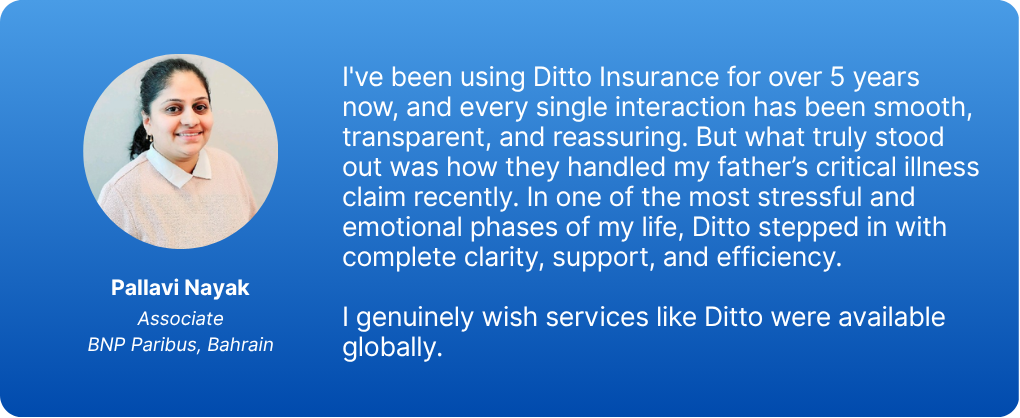
At Ditto, we’ve assisted over 8,00,000 customers with choosing the right insurance policy. Why customers like Pallavi below love us:
No-Spam & No Salesmen
Rated 4.9/5 on Google Reviews by 15,000+ happy customers
Backed by Zerodha
Dedicated Claim Support Team
100% Free Consultation
Confused about the right insurance? Speak to Ditto’s certified advisors for free, unbiased guidance. Book your call or chat on WhatsApp with us now!
Conclusion
Section 80D is one of the most practical tax-saving tools available to Indian taxpayers. It rewards you for doing something you should be doing anyway: protecting your health.
Here's how to move ahead:
Check whether the Old Tax Regime makes sense for your income and deductions.
Add up the health insurance premiums for yourself and your parents.
See where you stand against the ₹25,000/₹50,000 limits.
If you're not already maximizing them, there's room to increase your coverage and reduce your taxes at the same time.
Whether you're a salaried employee buying your first plan, someone with senior-citizen parents, or a self-employed individual exploring the Old Tax Regime, there's a good chance you can reduce your tax burden significantly.
Disclaimer
This guide is for informational purposes only and explains tax provisions under Section 80D based on publicly available laws and guidelines. Tax rules and their interpretations are subject to change, and individual circumstances may vary. Readers are advised to consult a qualified tax professional before making any decisions.
Frequently Asked Questions
What are the 80D and 80DD limits?
Section 80D lets you claim up to ₹25,000 for yourself, spouse, and dependent children if everyone’s age is below 60 for all, or up to ₹50,000 if the age is above 60 for anyone. You can claim another ₹25,000 or ₹50,000 for parents, bringing the total to ₹1,00,000 per year. Section 80DD is different. It is a flat deduction of ₹75,000 for a dependent with a disability and ₹1,25,000 for a dependent with a severe disability. These Chapter VI-A deductions are generally not available under the new tax regime.
Can I claim both 80D and 80C together?
Yes, you can claim both Section 80D and Section 80C together under the Old Tax Regime. Section 80C covers life insurance, PPF, ELSS, etc., with the combined 80C/80CCC/80CCD cap limited to ₹1,50,000. Section 80D is separate and can add up to ₹1,00,000 more, if both your block and your parents’ block qualify for ₹50,000 each. Additionally, Section 80CCD(1B) allows a separate NPS deduction of up to ₹50,000, taking the combined maximum to ₹3,00,000 for eligible NPS contributors.
Can we claim medical bills in 80D?
Yes, but only in specific cases. Section 80D primarily covers health insurance premiums, but it also allows medical expense claims of up to ₹50,000 for resident senior citizens without health insurance. It also allows preventive health check-up expenses up to ₹5,000, but that amount is included within the overall 80D limit, not added on top. For example, if you spend ₹42,000 on uninsured senior-citizen medical treatment, that ₹42,000 can be claimed, subject to the limit. Regular day-to-day medical bills for non-senior insured adults are not covered here.
Can I claim 80D without proof?
You usually do not need to upload documents while filing your ITR, but you should not claim Section 80D without proof. The Income Tax portal asks for details such as the insurer’s name, policy number, and health insurance premium amount when claiming 80D, and its filing FAQs also say you should keep health insurance receipts and other deduction proofs, especially if they are not already reflected in Form 16. A good practical rule is to retain premium receipts, proof of payment, and relevant bills for 6 years.
What is Section 80D in income tax?
Section 80D of the Income-Tax Act, 1961, allows taxpayers to claim deductions from their total gross income for health-related expenses. Unlike Section 80C, which focuses on investments, Section 80D of the Income Tax Act specifically targets premiums paid for medical insurance, contributions to the Central Government Health Scheme (CGHS), and preventive health check-ups. It is designed to lower the financial burden of healthcare for individuals and Hindu Undivided Families (HUFs). Depending on the age of the insured members, this Section 80D deduction can significantly reduce taxable income by up to ₹1,00,000 per financial year.
Is Section 80D deduction available in the New Tax Regime?
Under current tax laws, a deduction under Section 80D is not available if you opt for the New Tax Regime under Section 115BAC. The New Tax Regime offers lower tax rates but requires taxpayers to forgo most popular exemptions and deductions, including those for health insurance premiums and medical expenses. Therefore, if you are paying a significant premium for yourself or your senior citizen parents, you must evaluate whether the Old Tax Regime provides a higher overall tax saving.
Can I claim 80D for siblings or parents-in-law?
According to the Income Tax Act, 1961, you cannot claim any deduction for health insurance premiums paid for your brothers, sisters, grandparents, or in-laws, even if they are financially dependent on you. The deduction under Section 80D is strictly restricted to the taxpayer, their spouse, dependent children, and parents. To ensure your claim is valid, you must only declare expenses incurred for the specific family members defined under the Act's eligibility criteria.
Can I pay the health insurance premium in cash for Section 80D?
To successfully claim a deduction under Section 80D, the health insurance premium must be paid through non-cash modes, such as credit cards, debit cards, net banking, or cheques. Any premium paid in cash is strictly ineligible for Section 80D deduction benefits, regardless of the amount. However, there is one critical exception: payments made for preventive health check-ups. You are allowed to pay for these check-ups in cash and still claim a deduction of up to ₹5,000. It is essential to maintain digital receipts for all premium payments to provide proof at tax filing time.
How does Section 80D work for multi-year health insurance policies?
If you pay a lump sum premium for a multi-year health insurance policy, you can still claim the section 80D deduction, but it must be spread across the policy's duration. The total premium paid is divided proportionately by the number of years the policy is valid. For instance, if you pay ₹30,000 for a three-year policy, you can claim a deduction under section 80D of ₹10,000 in each of the three financial years. This ensures you do not lose the tax benefit in subsequent years and allows you to stay within the annual ₹25,000 limit while enjoying long-term coverage discounts.
Can I claim GST paid on health insurance in Section 80D?
When you pay your health insurance premium, you also pay 18% Goods and Services Tax (GST) on the base amount. The good news is that the total amount paid, including the GST, is eligible for section 80D deduction under the Income Tax Act. For example, if your base premium is ₹21,000 and the GST is ₹3,780, the total payment of ₹24,780 can be claimed as a deduction under section 80D, provided it stays within your applicable limit of ₹25,000 or ₹50,000. This ensures that the tax paid on the service does not become an additional financial burden. One important thing to note is that as of September 2025, GST has been removed for individual health insurance plans.
Customer Reviews
4.9
20915 reviews
Ditto is doing really great. Absolutely spam free- that's the best part. They don't talk to you like they are forced to sell the product. It's more like, helping us buy better. Advisor Nuha was very patient and answered all my questions with clarity. Thanks for the service
I
INDHUMATHI M
Loved the service! Maheta Nidhi Hitesh was incredibly helpful and knowledgeable. She guided me through the whole process and made everything super easy to understand. I really appreciated how patient she was with all my questions—there was no pressure at all, just clear and honest advice. Honestly, I'm very happy with my experience at Ditto so far. Highly recommend!
RK
Ragul Kumar
I had a great experience with Ditto while exploring health insurance options. The process was smooth and everything was explained clearly.
A special thanks to Swaroop SK for patiently answering all my questions and guiding me through the policy details without any pressure. The transparency and support made it much easier to understand and choose the right plan.
Really appreciate the assistance!
PS
Pulkit Singh
Had a great experience with Ditto Insurance. Ishita Sudrania was extremely helpful in guiding me through choosing the right term plan. There was no spamming or sales pressure, and all my questions were patiently answered. She also assisted me thoroughly with the entire application process. Highly recommend!
SS
Samil Shah
I had a great experience with Ditto while filing my health insurance claim. Their team guided me clearly through the entire process, helped with the required documents, and promptly answered all my queries. Their support made the claim process much smoother and less stressful. Highly appreciate their assistance.